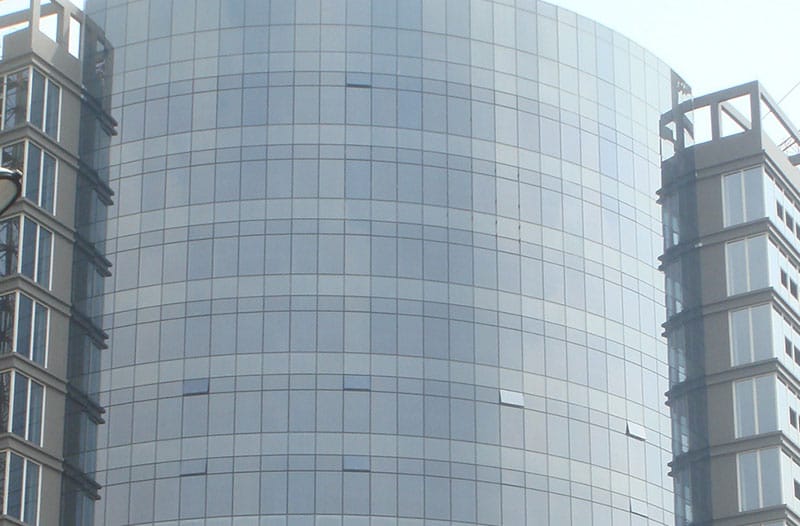
Among the modern architectural decorative glass curtain walls, the exposed frame glass curtain wall and the hidden frame glass curtain wall are the most common mainstream curtain wall forms. So which glass curtain wall architectural form is more suitable for your building type? Today, Zhongdong analyzes the types of glass curtain walls for you from the aspects of aesthetic performance, cost maintenance, and environmental adaptability, hoping to help you find a good glass curtain wall for your office.
1 Exposed frame glass curtain wall
– Core structure:
The glass panel is directly supported by an exposed metal frame (mainly aluminum profiles), and the frame is fixed to the main structure of the building by bolts or slots. The glass is usually embedded in the groove of the frame, supplemented by a pressure plate and a sealing strip.
– Key technical points:
– Drainage system: A water guide groove is preset in the frame to effectively deal with rainwater penetration.
– Thermal expansion treatment: Expansion joints are reserved at the frame nodes to adapt to temperature difference deformation.
– Load transfer: The vertical load is borne by the column, and the horizontal load is dispersed to the main structure through the beam.
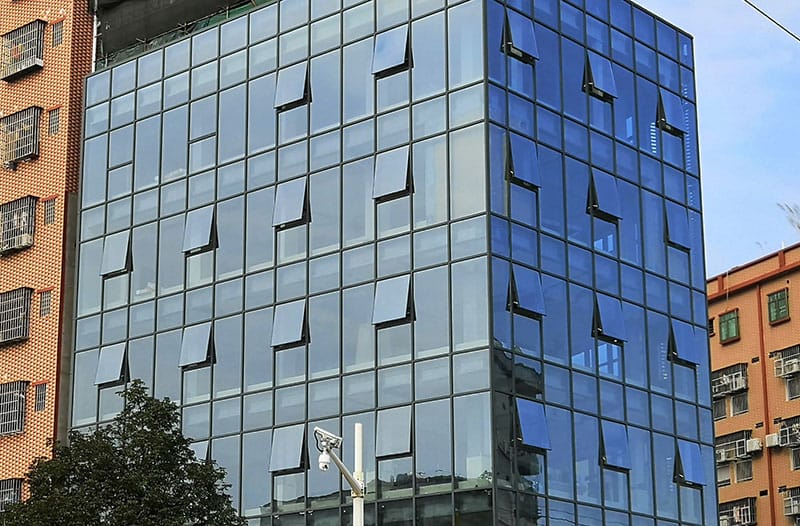
1 Hidden frame glass curtain wall
– Core structure:
The glass is directly bonded to the metal sub-frame (the sub-frame is hidden inside the glass) through high-strength structural adhesive, and there is no visible frame on the outside, forming a continuous “all-glass” visual effect. The main keel is usually embedded in the building wall or glass joint.
– Key technical points:
– Structural adhesive performance: It must pass tensile, shear, and aging tests (such as silicone adhesive life must be more than 25 years).
– Stress distribution: The bonding surface between glass and sub-frame must be accurately calculated to avoid local stress concentration.
– Isobaric cavity design: Reduce the risk of rainwater infiltration through air pressure balance.
Aesthetic expression of exposed frame and hidden frame glass curtain wall
2 Visual expression of exposed frame curtain wall
– Style characteristics:
The exposed metal lines form regular divisions, giving the building a clear sense of geometric order, which is suitable for designs that emphasize structural logic.
– Design flexibility:
The personalized facade can be customized through frame color (such as champagne gold, matte black) and cross-section shape (arc, diamond).
2 Minimalist philosophy of hidden frame curtain wall
– Style features:
Eliminate visual segmentation and create a “boundless” sense of transparency, which is in line with avant-garde design concepts such as futurism and digital aesthetics.
– Innovative applications:
Ultra-clear glass, Low-E coating, glaze printing and other technologies can further enhance the pure texture or create gradient and pixelated artistic effects.
Chapter 3 Cost and life cycle management
3.2 Long-term maintenance costs of exposed frame glass curtain wall and hidden frame glass curtain wall
– Advantages of exposed frame curtain wall:
– The exposed frame is convenient for regular inspection of problems such as loose screws and aging of rubber strips.
– Partial replacement of glass does not require destruction of the overall structure, and the repair cost of a single piece is 30%-50% lower than that of hidden frame.
– Challenges of hidden frame curtain wall:
– Glass breakage may cause failure of surrounding bonding, requiring replacement of the entire piece and re-gluing.