
As a distinctive feature in modern architecture, a glass curtain wall refers to an external building envelope or decorative structure. Its supporting system can move relative to the main structure and does not bear the loads acting on the main structure.
In terms of composition, a glass curtain wall mainly consists of glass panels, a supporting structure system, and connecting components. The glass panel is the core part of the curtain wall. It not only determines the appearance of the curtain wall but also directly affects its performance in lighting, heat insulation, and sound insulation.
Frame-Supported Glass Curtain Walls
Frame-supported glass curtain walls are the most common type, with glass panels supported by metal frames around their edges. This type can be further divided into exposed-frame glass curtain walls and hidden-frame glass curtain walls.
Exposed-Frame Glass Curtain Walls
The metal frame components of exposed-frame glass curtain walls are visible on the outer surface, creating a unique visual effect. They use aluminum profiles with special cross-sections as the frame, and the glass panels are fully inserted into the grooves of the profiles. The aluminum profiles here serve both as the skeleton structure and for fixing the glass.
Exposed-frame glass curtain walls are the most traditional type and are widely used in various buildings, with reliable performance. Their visible metal frames not only add a sense of hierarchy to the building but also bring a stable and neat visual impression. Due to their intuitive structural form, the technical requirements for construction are relatively low, allowing construction teams with less experience to complete the installation well. In office buildings that pursue a minimalist style, the application of exposed-frame glass curtain walls can present a simple and elegant appearance, while their good stability can meet the long-term use needs of the building.
Hidden-Frame Glass Curtain Walls
The metal frames of hidden-frame glass curtain walls are concealed behind the glass, making them invisible from the outside. This gives the curtain wall a concise and smooth overall look, as if a large single piece of glass is inlaid on the building facade, greatly enhancing the building’s modern feel and transparency.
Hidden-frame glass curtain walls can be further divided into fully hidden-frame and semi-hidden-frame types. Semi-hidden-frame glass curtain walls can have exposed horizontal frames with hidden vertical frames, or exposed vertical frames with hidden horizontal frames. This design balances the building’s aesthetic and structural needs to a certain extent.
In the structure of hidden-frame glass curtain walls, the glass is placed outside the aluminum frame. Structural silicone sealant is used to bond the glass to the aluminum frame, and the sealant mainly bears the loads on the curtain wall. Therefore, the quality and performance of the structural silicone sealant are crucial, directly affecting the safety and service life of the curtain wall. When selecting the sealant, it must comply with relevant standards and specifications to ensure good adhesion, weather resistance, and anti-aging properties.
High-end office buildings, hotels, and other structures often use hidden-frame glass curtain walls to pursue an ultimate appearance and modern style, highlighting the unique charm and quality of the building.
Point-Supported Glass Curtain Walls
Point-supported glass curtain walls connect glass panels to the supporting structure through point-supporting devices. Their supporting structures come in various forms, including glass rib supports, steel structure supports, and cable supports.
In this curtain wall system, the glass panels are only connected to the supporting structure at a few points, with almost no obstruction. This achieves excellent transparency and maximum visibility, maximizing the transparency of the glass.
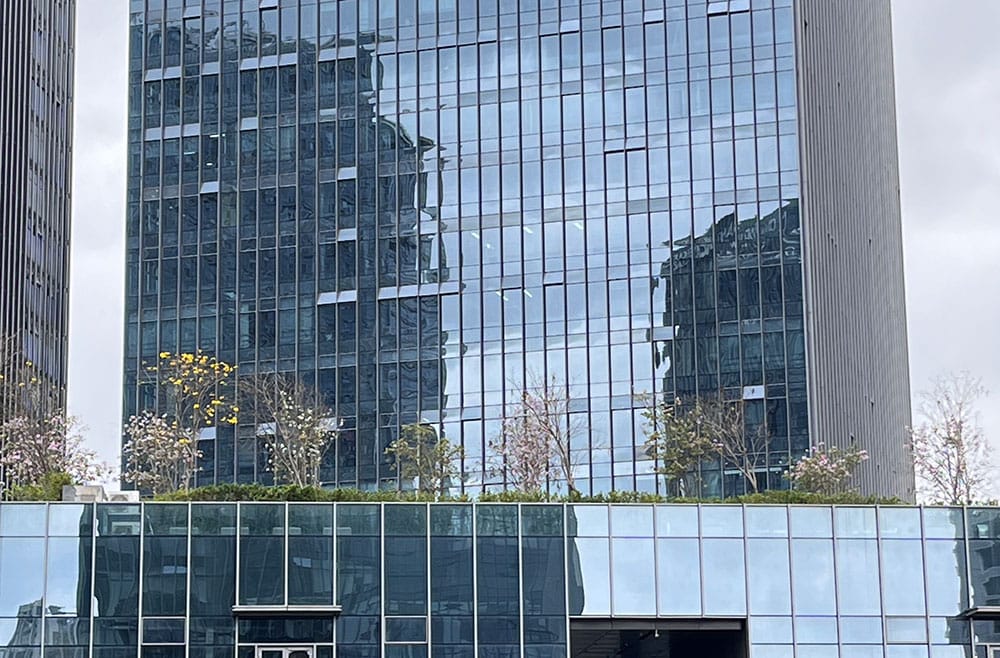
In buildings such as art galleries and commercial complexes, the application of point-supported glass curtain walls can create a unique visual effect, enabling better integration of the building’s interior and exterior spaces.
Point-supported glass curtain walls with steel structure supports have high strength and stability, capable of adapting to large spans and load requirements. Cable supports are lighter and more flexible, able to create unique architectural shapes and add a sense of agility to the building.
Since the glass panels of point-supported glass curtain walls are only connected via points, the design and construction process have extremely high requirements for the strength and rigidity of the supporting structure, as well as the reliability of the connection nodes. This ensures the safety and stability of the curtain wall under various loads.
Full-Glass Curtain Walls
Full-glass curtain walls are composed of glass ribs and glass panels, with almost no visible metal framework. They give a concise and transparent feel, as if the building is wrapped in a layer of transparent crystal, achieving maximum integration of indoor and outdoor spaces.
Full-glass curtain walls have two support methods: floor-mounted and suspended. Floor-mounted full-glass curtain walls are supported by glass ribs or metal beams at the bottom, and may have hanging rods at the top. They are suitable for lower spaces, such as building facades within 6 meters, like hotel lobbies and commercial storefronts.
Suspended full-glass curtain walls are hung from steel frames or hanging rods at the top, with the bottom freely suspended. This method can effectively prevent the glass from bending and is suitable for higher spaces, such as cross-floor atriums.
Full-glass curtain walls have extremely high transparency, providing users with unobstructed views and allowing people to better enjoy the surrounding environment. However, since they are almost entirely made of glass, their cost is relatively high, and they have strict requirements for glass quality and installation technology to ensure the safety and stability of the curtain wall.
High-end buildings that pursue high quality and unique design, such as luxury hotels and art centers, often use full-glass curtain walls to showcase their unique architectural style and taste.
Unitized Curtain Walls
Unitized curtain walls are prefabricated in factories as complete basic units, including various wall surfaces and supporting frames. These units are then directly transported to the construction site and installed on the main structure.
During factory production, strict quality control can be applied to the curtain wall units, ensuring that the dimensional accuracy and performance of each unit meet the requirements. The installation process of unitized curtain walls is similar to building with blocks: the curtain wall units are hoisted and fixed to the main structure one by one. This significantly shortens the on-site construction period, reduces noise, dust, and other pollution at the construction site, and lowers construction safety risks.
Unitized curtain walls are easy to install, have a short construction period, and their quality is easier to control. Since most of the processing and assembly of unitized curtain walls is completed in the factory, on-site installation is less affected by external factors such as weather, ensuring the smooth progress of the construction schedule.
Unitized curtain walls also have excellent performance in waterproofing, fire resistance, and sound insulation, meeting the high-quality requirements of modern buildings. They are widely used in high-rise and super high-rise buildings, such as the Shanghai Tower. Their efficient construction method and outstanding performance provide strong support for the successful completion of the building.

