Keywords: glass curtain wall, building facade, curtain wall system, doors and windows
I. Cognitive differences between glass curtain wall and doors and windows
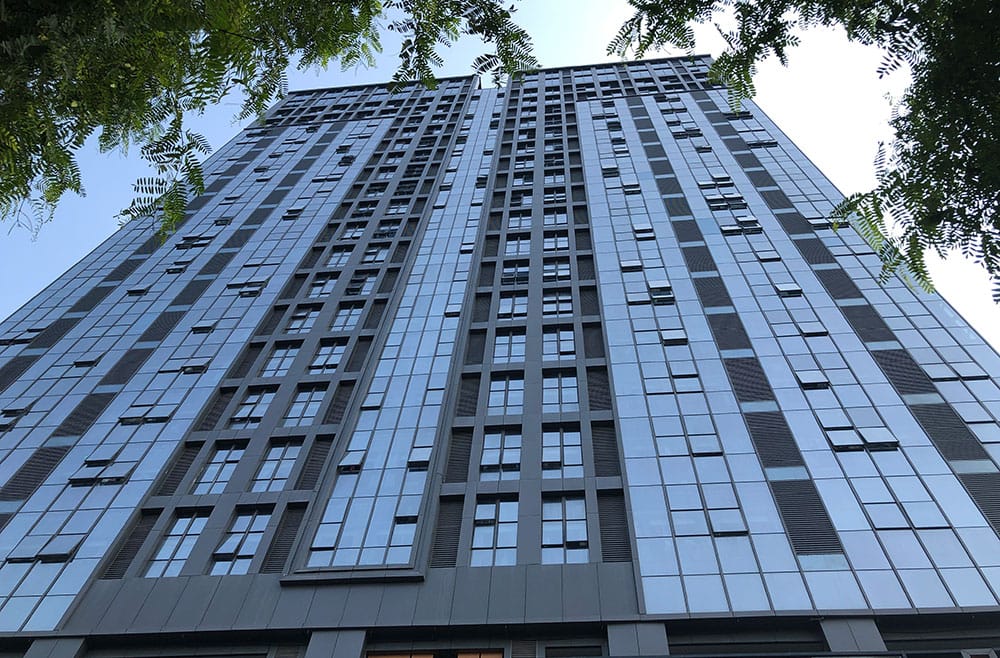
As a landmark element of modern architecture, the glass curtain wall is a continuous external enclosure structure system supported by a metal frame, with the characteristics of an integrated building skin. In contrast, doors and windows are independent functional units that can be opened and closed in the building envelope structure, and they undertake the core functions of lighting and ventilation. Although both belong to the building’s external enclosure system, the glass curtain wall emphasizes architectural aesthetic expression and structural integration, while doors and windows focus on the realization of practical functions.
II. Comparative analysis of the characteristics of glass curtain walls and doors and windows
1. System construction differences
The glass curtain wall adopts a unit/frame structure system, which needs to consider complex mechanical conduction such as wind loads and earthquake effects
Doors and windows are standardized modular components, and their installation depends on the reserved size of the opening.
2. Material selection standards
Safety glass (tempered/laminated) is mandatory for glass curtain walls, and the wall thickness of aluminum profiles is ≥3mm
Ordinary hollow glass can be used for doors and windows, and plastic steel/aluminum alloy profiles are more flexible
3. Performance parameter requirements
Wind pressure resistance: curtain walls must reach level 1 (≥5kPa) vs. level 4 for doors and windows (≥2.5kPa)
Water tightness: level 3 for curtain walls vs. level 4 for doors and windows (national standard GB/T7106 classification)
III. Detailed explanation of the differences in functional positioning between glass curtain walls and doors and windows
1. Core functions of glass curtain walls
Architectural aesthetic carrier (accounting for 15-25% of project costs)
Overall energy-saving control (heat transfer coefficient ≤2.0W/(㎡·K))
Structural displacement compensation (interlayer displacement angle adaptation 1/250)
2. Core functions of doors and windows
Daily use convenience (opening frequency > 10,000 times)
Local thermal regulation (K value ≤ 1.8 in the northern region)
Emergency escape route (minimum opening size 600×800mm)
3. Comparison of special functions
85% maturity of curtain wall integrated photovoltaic power generation (BIPV) technology
The penetration rate of intelligent control systems for doors and windows has increased by 23% annually
IV. Technical specifications and certification system for glass curtain walls and doors and windows
1. Mandatory specifications for glass curtain walls
JGJ102-2003 technical regulations
Four-property tests must be performed (airtightness/watertightness/wind pressure resistance/plane deformation)
Design service life ≥ 25 years
2. Certification standards for doors and windows
Energy-saving label certification (three-star green building requirements)
Conventional warranty period 5-10 years
3. Differences in testing methods
Curtain walls require on-site water spraying test (water volume ≥ 3L/(㎡·min))
Doors and windows use laboratory simulation testing
V. Comparison of economic efficiency and maintenance costs
| Comparison dimensions | Glass curtain wall | Door and window system |
|————————————————|———————————————-|———————————————————|
| Initial cost | 800-2000 yuan/㎡ | 400-800 yuan/㎡ |
| Maintenance cycle | 5-year special inspection | 8-10-year sealing strip replacement |
| Maintenance cost ratio | Annual average 0.8-1.2% | Annual average 0.3-0.5% |
| Energy saving payback period | 7-12 years (LOW-E hollow) | 3-5 years (three-glass two-cavity) |
VI. Analysis of typical application scenarios of glass curtain walls and doors and windows
Advantage scenarios of glass curtain walls
Super high-rise buildings (92% of projects with height greater than 100m)
Commercial complexes (40-60% of curtain wall area)
Green building certification projects (LEED/BREEAM bonus points)
Doors and windows applicable areas
Residential projects (window-to-wall ratio ≤ 0.4 as required by regulations)
Historical building renovation (matching the original architectural style)
Special function spaces (bulletproof/explosion-proof windows)