
In modern architecture, glass has become an essential element — from residential buildings to commercial complexes, and from office towers to airport terminals, transparent glass facades are everywhere. However, when looking at a building’s exterior, many people wonder: Is that a window or a glass curtain wall?
While the two may look similar, especially on large buildings, they differ fundamentally in structure, safety, function, and construction methods.
1. Definitions: Window vs. Glass Curtain Wall
To understand how to distinguish between a window and a curtain wall, we first need to define them.

Window
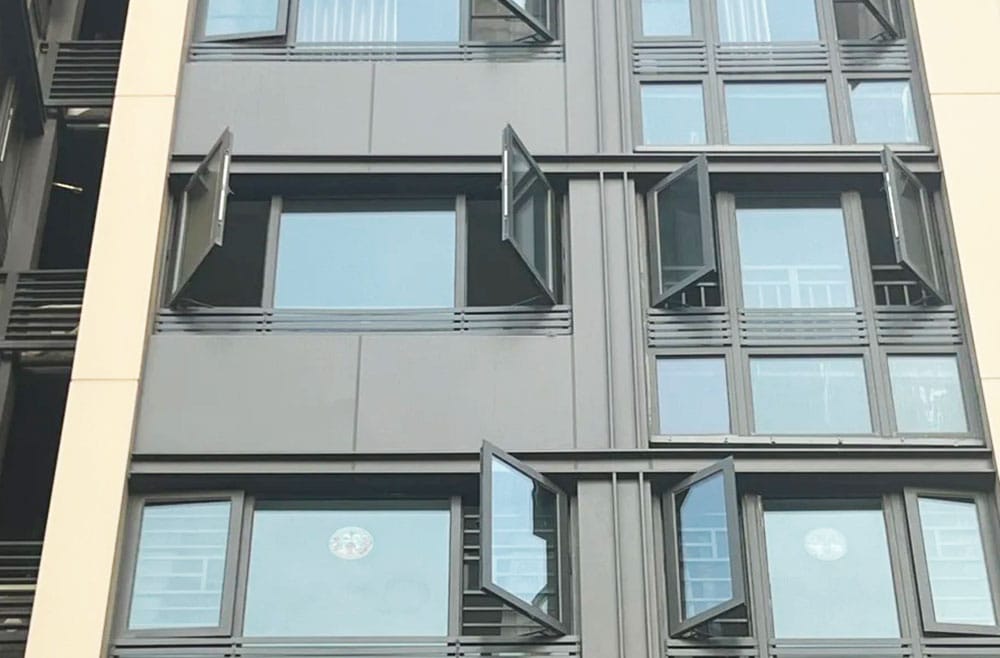
A window is an opening installed within the wall of a building for light and ventilation. It is attached to the main structural wall and can be opened or closed. The window frame is embedded into the concrete or brick wall, and openings are often designed for ventilation or emergency escape.
Glass Curtain Wall
A curtain wall, on the other hand, is an independent exterior cladding system — a “second skin” that covers the building structure. It does not bear structural loads but is supported by an aluminum or steel framework fixed to the main structure. Curtain walls serve multiple purposes: enclosure, aesthetics, thermal insulation, and acoustic control.
In simple terms:
A window is part of the wall.
A curtain wall is a complete external facade system that covers the building.
This is the first and most fundamental distinction.
2. Structural Characteristics
In practice, the structural form provides the most direct way to tell them apart.
Features of Windows:
Frames are embedded directly into the wall (concrete or brick).
Usually have openable sashes (e.g., sliding, casement, or top-hung).
Small in size; a single pane rarely exceeds 2 m².
Simple structure with shallow installation depth.
Features of Glass Curtain Walls:
Supported by vertical mullions and horizontal transoms or a steel framework.
Installed outside the main structure via connectors or brackets.
Designed as modular systems with large, continuous glass panels.
Usually fixed; only small sections may be operable.
Include drainage, waterproofing, and thermal expansion systems.
Observation tip: If the facade is composed of large, continuous glass surfaces with no visible wall breaks, it is almost certainly a curtain wall.
3. Installation and Load-Bearing Differences
The installation method and load transfer mechanism also reveal key differences.
Windows: Installed within wall openings; rely on the surrounding structure for support; mainly bear self-weight and part of the wind load.
Curtain Walls: Installed outside the structure; loads such as wind pressure, gravity, and seismic forces are transferred through the supporting frame to the main structure via flexible connectors.
Put simply:
A window is an opening in the wall,
whereas a curtain wall is an external skin covering the entire facade.
4. Visual and Detail Clues
Although windows and curtain walls may look similar, you can identify them by the following details:
1. Separation lines between glass panels:
Visible thick frames or openable sections suggest windows. Smooth, seamless joints indicate curtain walls.
2. Openability:
If the panel can be opened, it’s almost certainly a window. Curtain walls are mostly fixed, with limited operable vents.
3. Reflectivity:
Curtain walls often use large coated or insulated glass panels with strong reflectivity — almost mirror-like.
Windows tend to be less reflective and more transparent.
4. Frame width:
Curtain wall mullions are typically wider (over 50 mm) for structural strength, while window frames are thinner (30–40 mm).
With these visible cues, even non-professionals can make a reasonable distinction.
5. Functional Differences
Functions of Windows:
Natural ventilation
Daylighting
Thermal and acoustic insulation
Providing outdoor views and emergency escape routes
Functions of Curtain Walls:
Architectural appearance and enclosure
Wind, rain, and thermal protection
Energy efficiency and temperature control
Resistance to external loads (wind, seismic, etc.)
Integration of energy-saving technologies (e.g., double-skin facades)
Clearly, curtain walls are far more complex and system-oriented than ordinary windows.
6. Construction Process
The installation processes are completely different.
Window Installation:
Installed after wall construction or plastering.
Short construction time and simpler process.
Usually handled by a window installation contractor.
Curtain Wall Installation:
Begins after the main structure is completed.
Requires detailed engineering design, structural analysis, and waterproofing plans.
High installation precision and longer duration.
Conducted by specialized curtain wall companies, involving coordination among architectural, structural, and safety disciplines.
Thus, a curtain wall is a system project, whereas a window is merely a single component.
7. Maintenance and Inspection
Windows: Simple maintenance—mainly replacing hardware or seals.
Curtain Walls: Require regular inspections of structure, sealants, and waterproofing systems; often demand high-altitude maintenance equipment such as gondolas or suspended platforms.
If cleaning or inspection needs to be done from outside the building with special equipment, it’s almost certainly a curtain wall.
8. Real-World Examples
Office Buildings: If the exterior appears as a seamless glass facade with no visible walls or beams between floors, it is most likely a curtain wall.
Residential Complexes: Enclosed balconies with aluminum-framed glass are typically window systems rather than curtain walls, since they do not bear facade loads.
9. Conclusion: Why the Distinction Matters
Understanding how to distinguish between windows and glass curtain walls is not just an academic exercise — it’s crucial for safety, energy performance, and maintenance planning.
For building owners, knowing which system is used helps with purchasing, acceptance, and upkeep decisions.
For designers and engineers, it clarifies professional boundaries, cost control, and construction schedules.

