
— A Professional Guide for International Architects, Contractors, and Developers
In today’s global construction market,glass curtain wallshave become one of the defining elements of modern architectural façades. Whether for office towers, hotels, shopping malls, airports, or hospitals, glass curtain walls bring a sense of lightness, transparency, and modernity to buildings—enhancing both their visual appeal and energy efficiency. At the early stages of a project, one of the most important concerns for owners and contractors is thequotation for glass curtain wall contracting.
This article provides a comprehensive overview of what a glass curtain wall contracting quotation entails—covering its definition, influencing factors, construction process, cost components, advantages, application fields, and future trends. It aims to help global clients better understand the value and budgeting principles behind curtain wall projects.
1. What Is a Glass Curtain Wall Contracting Quotation?
Aglass curtain wall contracting quotationrefers to the comprehensive cost proposal provided by a curtain wall contractor based on the project’s architectural drawings, design requirements, material specifications, and site conditions. It typically includes the full scope of services—from design, material supply, fabrication, transportation, and installation to final inspection and handover.
Unlike the traditional “materials + labor” pricing model, this quotation often follows theEPC model (Engineering, Procurement, and Construction)—where one specialized curtain wall company assumes full responsibility for the entire process, ensuring consistency in design, cost, quality, and schedule.
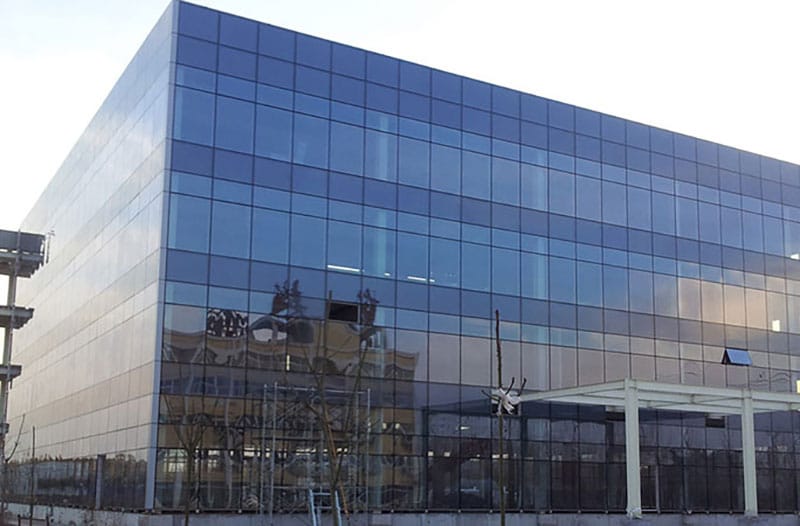
A detailed glass curtain wall contracting quotation generally includes:
1.Material Costs:Glass, aluminum profiles, sealants, mullions, stainless steel fittings, etc.
2.Labor Costs:Fabrication, on-site installation, welding, sealing, and commissioning.
3.Design and Engineering Costs:Structural analysis, detailed drawings, BIM modeling, and energy analysis.
4.Transportation and Hoisting Costs:Logistics and lifting equipment for large glass panels and frame components.
5.Management and Insurance Costs:Site management, safety assurance, project insurance, and taxes.
2. Key Factors Affecting Curtain Wall Contracting Prices
In practice, thecost of a glass curtain wall contracting packagevaries widely depending on multiple factors:
1.Type of Curtain Wall
Common types include unitized systems, stick systems, point-supported systems, full-glass façades, and double-skin façades. Each type differs in structural complexity and manufacturing requirements, which significantly affect cost.
Unitized Curtain Wall:High installation efficiency but higher upfront fabrication costs.
Stick System:Suitable for small to medium-sized projects, with lower costs.
Point-Supported System:Offers superior transparency and aesthetics but uses more expensive hardware.
2.Glass Specifications and Performance
The choice of glass—such as ultra-clear glass, Low-E glass, laminated or insulated glass, or curved glass—directly determines cost. Higher requirements for energy efficiency, fire resistance, safety, or acoustics increase the unit price.
3.Building Height and Installation Conditions
High-rise and super high-rise projects require special lifting equipment and safety measures, raising labor and logistics costs.
4.Design Complexity and Geometry
Customized, curved, or double-curved façades demand precision fabrication and high installation accuracy, resulting in significantly higher costs.
5.Regional and Logistics Costs
Labor rates, material prices, import duties, and transportation distances vary by country or region, influencing the overall quotation.
Therefore, an accurateglass curtain wall contracting quotationmust be based on detailed design documents, construction drawings, and technical consultations, prepared by a professional curtain wall contractor.
3. Core Advantages of Glass Curtain Wall Contracting
Choosing a professionalcontracting modeloffers significant advantages for international developers and general contractors:
1.Cost Control
Integrating design, procurement, and construction under one company avoids duplicated efforts and communication errors. Pricing is transparent and clearly itemized.
2.Quality Assurance
Reputable curtain wall companies follow systematic quality control procedures—from material inspection and fabrication to on-site installation—ensuring compliance with international standards.
3.Schedule Reliability
With a unified team managing the entire workflow, construction progress can be precisely coordinated using BIM and project scheduling tools.
4.Centralized Risk Management
Contracting directly with a single curtain wall company minimizes coordination issues among subcontractors and enhances project efficiency.
5.Technological Innovation and Energy Efficiency
By participating early in the design stage, the contractor can provide expert recommendations on energy-saving glass options, shading systems, and renewable energy integration.
4. Application Fields of Glass Curtain Wall Contracting
With increasing demands for high-performance façades,glass curtain wall contracting solutionsare widely adopted in:
1.Super High-Rise Office Buildings
Such as international financial centers and CBD landmarks, requiring high-strength structures and energy-efficient glazing systems.
2.Five-Star Hotels and Mixed-Use Complexes
Prioritizing aesthetics and comfort, often using double-skin façades or point-supported systems for enhanced visual effects.
3.Large Commercial and Exhibition Centers
Featuring extensive façade areas and complex geometries, where the contracting model improves coordination and safety.
4.Airports, Hospitals, and Public Buildings
Demanding high transparency, daylighting, acoustic insulation, and safety performance, best achieved through systematic curtain wall solutions.
5.Projects in the Middle East and Tropical Regions
Designed for hot climates with a focus on insulation, sand resistance, and energy efficiency. Many Middle Eastern tenders require acomplete curtain wall contracting quotationto ensure long-term performance and easy maintenance.
5. Future Trends: Smart and Sustainable Façades
Tomorrow’s curtain walls will function as an“intelligent skin”—integrating technology and environmental interaction. Futurecurtain wall contracting quotationswill encompass not only materials and construction but also smart and sustainable technologies.
1.Smart Dimming Glass Façades
Automatically adjust transparency based on sunlight and temperature, reducing energy consumption.
2.Building-Integrated Photovoltaic (BIPV) Systems
Incorporate solar panels directly into the façade, enabling on-site energy generation and carbon reduction.
3.Modular and Prefabricated Construction
Factory fabrication and on-site assembly improve precision, efficiency, and safety.
4.AI and BIM Integration
AI-driven design optimization and energy analysis enable precise cost estimation and predictive maintenance.
Thus, futurecurtain wall contracting quotationswill represent not just a price list but a comprehensive solution combining design, technology, energy performance, and intelligence.
6. Conclusion: Choosing the Right Curtain Wall Partner
In a competitive global construction landscape, a transparent, reasonable, and professionalglass curtain wall contracting quotationis not only the foundation for budgeting but also a key indicator of a contractor’s technical strength.
When selecting a partner, consider whether the company:
Has international project experience and certifications (ISO, ASTM, EN standards);
Provides full-scope services from design to installation;
Offers professional cost analysis and quotation systems;
Possesses expertise in green building and smart façade technologies.
A trustworthy curtain wall company can balance cost control with long-term value—delivering architecture that stands out in aesthetics, performance, and sustainability.

