
What are the advantages of using aluminum alloy glass curtain wall

With the acceleration of urbanization and the iteration of building technology, modern buildings have increasingly higher requirements for material performance and aesthetic expression. In this context, aluminum alloy glass curtain wall has gradually become the preferred facade curtain wall solution for high-rise buildings, commercial complexes and public facilities with its unique comprehensive advantages. This article will systematically analyze the core value of aluminum alloy glass curtain wall from multiple dimensions such as material properties, design aesthetics, energy saving and environmental protection, construction and maintenance.
1. Material Science Perspective: The Perfect Combination of Aluminum Alloy and Glass
The core material combination of aluminum alloy glass curtain wall-aluminum alloy profiles and tempered glass, reflects the scientific synergy of modern building materials. As a lightweight and high-strength metal material, aluminum alloy has a density of only 1/3 of that of steel, but through alloying treatment and precision extrusion process, the tensile strength can reach more than 300MPa, which can easily cope with the wind load and earthquake of high-rise buildings. At the same time, the corrosion resistance of aluminum alloy is far superior to that of ordinary steel. After the surface is anodized or fluorocarbon sprayed, it can remain non-fading and non-oxidized for decades in extreme climates.
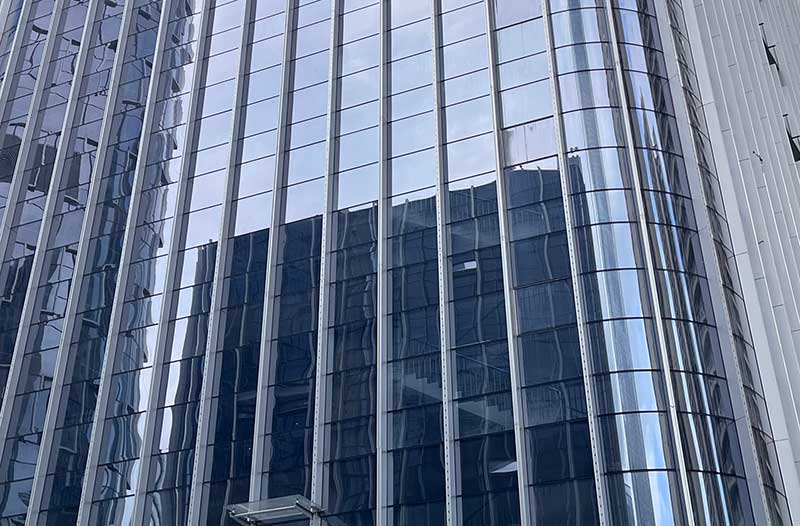
 

aluminum glass curtain wall

As a transparent enclosure structure of the curtain wall, tempered glass breaks through the limitations of traditional materials. Its impact resistance is 510 times that of ordinary glass, and it is in the form of particles without sharp corners when broken, which significantly improves the safety of the building. Through LowE coating, hollow argon filling and other technologies, the heat transfer coefficient (U value) of glass can be reduced to below 1.0 W/(㎡·K), achieving a leap in thermal performance. This “rigid and flexible” material combination enables the aluminum alloy glass curtain wall to not only bear structural stress, but also have excellent light transmittance and climate adaptability.
2. Architectural aesthetic innovation: from functional components to spatial narrative
In contemporary architectural design, aluminum alloy glass curtain walls have evolved from a simple external enclosure structure to a core carrier of spatial aesthetics. Its design advantages are reflected in three aspects:
1. Visual transparency and spatial extension
The large area of ​​glass panels combined with the slender aluminum alloy frame (the width can be reduced to less than 50mm) eliminates the heavy feeling of traditional walls. For example, the Ping An Financial Center in Shenzhen, China, uses a unitized curtain wall system. Through the design of 6mm ultra-clear glass and invisible glue joints, it achieves the visual effect of the building facade “disappearing”, integrating the city skyline into the interior space.
2. Plasticity of shape and modular innovation
Aluminum alloy profiles can achieve special-shaped structures such as arcs and broken lines through CNC bending technology. The dome theater of the Shanghai Planetarium uses a hyperbolic aluminum alloy glass curtain wall. 3,800 pieces of glass of different sizes prefabricated through BIM technology accurately fit complex geometric surfaces to create a sci-fi image of “celestial orbit”.
3. Customized expression of color texture
Powder spraying technology enables aluminum alloy frames to present more than 200 colors such as champagne gold and titanium gray, and combines with innovative materials such as colored glaze glass and photoelectric glass to create a dynamic facade effect. The C-shaped column curtain wall system of Beijing Daxing International Airport simulates the light and shadow rhythm of “Phoenix Spreading Wings” through the combination of gradient glaze point glass and silver aluminum frame.
3. Energy saving and environmental protection: pioneer in the practice of green buildings
Driven by the “dual carbon” strategy, the sustainable advantages of aluminum alloy glass curtain walls are becoming more and more prominent:
1. Breakthrough in thermal performance
The overall heat transfer coefficient of the curtain wall can be as low as 0.8 W/(㎡·K) by combining broken bridge aluminum alloy profiles (insulation strip width can reach 30mm) with triple silver LowE hollow glass. The intelligent curtain wall system of Guangzhou Zhujiang City Building reduces building energy consumption by more than 40% through the combination of adjustable ventilators and photovoltaic glass.
2. Integration of renewable energy
The new generation of curtain wall technology directly embeds cadmium telluride thin-film photovoltaic modules into the glass interlayer, with a conversion efficiency of 18% while maintaining a light transmittance of 70%. The photovoltaic curtain wall of Xiongan Business Service Center generates more than 120,000 kWh of electricity per year, demonstrating the energy autonomy potential of the building’s skin.
3. Environmental protection throughout the entire life cycle
The recycling rate of aluminum alloy materials exceeds 95%, and the energy consumption of recycled aluminum production is only 5% of that of original aluminum. With the design of detachable curtain wall units, more than 90% of materials can be recycled during building renovation, which is in line with the concept of circular economy.
IV. Advantages of engineering practice: double improvement of efficiency and precision
Compared with traditional curtain wall technology, aluminum alloy glass curtain wall has shown significant technological progress in the construction process:
1. Prefabricated production and rapid installation
More than 85% of the processes of unit curtain wall are completed in the factory (including glass assembly and sealant construction), and the on-site installation speed can reach 8001000 square meters per day. The T2 terminal project of Chengdu Tianfu International Airport completed the installation of 120,000 square meters of curtain wall in 3 months through BIM-driven modular construction, shortening the construction period by 40%.
2. Fault-tolerant mechanism and maintenance convenience
The open structural design of the exposed frame curtain wall system allows the independent replacement of a single piece of glass. The curtain wall detection robot equipped with Shanghai Tower can quickly locate damaged units along the track system, and the maintenance efficiency is improved by more than 70%.
3. Integration of intelligent monitoring system
The sensor network embedded in the curtain wall structure can monitor parameters such as wind pressure, temperature, and air tightness in real time. The curtain wall health monitoring system of the Hangzhou Wisdom Gate Twin Towers generates a structural safety report every 30 minutes to achieve preventive maintenance.
V. Application scenario expansion: from super high-rise to urban renewal
At present, the application of aluminum alloy glass curtain walls has broken through the boundaries of traditional fields:
Super high-rise buildings: Suzhou Zhongnan Center uses 1.2m wide glass units to reduce vertical glue joints by 60%, achieving seamless visual effects at an altitude of 500 meters.
Historical building renovation: In the renovation project of the Berlin Reichstag, the nested design of the lightweight curtain wall system and the original stone facade balances the requirements of cultural protection and modern functional needs.
Finally: The technological evolution of aluminum alloy glass curtain walls for the future
With the penetration of technologies such as smart materials and digital twins, aluminum alloy glass curtain walls are evolving towards adaptive adjustment (such as thermochromic glass), energy self-sufficiency (photovoltaic energy storage integration), and interactive interfaces (AR projection curtain walls). This continuous technological iteration not only reshapes the city’s skyline, but also essentially promotes the reconstruction of the relationship between architecture, people and the environment. In the foreseeable future, aluminum alloy glass curtain walls will continue to be the key carrier of architectural innovation, creating more efficient and sustainable living spaces for humans.

发表评论

您的邮箱地址不会被公开。 必填项已用 * 标注