
From the glass cladding style of New York’s Empire State Building to the full-glass exterior of Dubai’s Burj Khalifa, glass curtain walls have become an iconic element of modern architecture. With their unique sense of transparency and visual impact, they have reshaped urban skylines while sparking in-depth discussions about functionality and sustainability. For decision-makers of global construction projects, a clear understanding of the advantages and disadvantages of glass curtain walls is a key prerequisite for selecting reliable curtain wall solutions. This article analyzes glass curtain walls from four dimensions—product characteristics, core advantages, application scenarios, and limitations—to provide comprehensive and practical references for international clients.
1. Product Characteristics of Glass Curtain Walls: Dual Innovation in Structure and Materials
A glass curtain wall is not a single product but a building exterior protection system composed of a structural framework and glass materials. Its core characteristics lie in the diversity of structural forms and the professionalism of material performance.
(1) Structural Forms: Adapting to Different Architectural Needs
The mainstream structural forms include three categories: frame-supported, point-supported, and all-glass curtain walls.
Frame-supported curtain walls fix glass via aluminum alloy or steel frames. As the most widely used type, they balance stability and cost-effectiveness, making them suitable for mid-to-high-rise office buildings.
Point-supported curtain walls connect glass to load-bearing structures using stainless steel spider fittings. They feature unobstructed visibility and are often used in landmark buildings pursuing extreme transparency, such as the National Centre for the Performing Arts in Beijing.
All-glass curtain walls consist of glass ribs and face glass. They are lightweight and smooth, ideal for low-rise public spaces or building entrances.
These three structural forms can be flexibly selected based on building height, design requirements, and budget, demonstrating the adaptability of glass curtain walls.
(2) Material Performance: Core Support from Technological Empowerment
Glass materials for modern curtain walls have broken traditional limitations and possess multiple professional properties.
High strength: Tempered glass has an impact resistance 3–5 times that of ordinary glass, meeting building safety requirements.
Controllable light transmission: Low-E (low-emissivity) glass selectively transmits visible light while blocking infrared and ultraviolet rays, balancing natural lighting and energy efficiency.
Enhanced functionality: Composite glass products such as laminated glass and insulated glass further improve sound insulation, thermal insulation, and blast resistance of curtain walls.
Advancements in material technology lay the foundation for functional upgrades of glass curtain walls.
2. Distinct Advantages of Glass Curtain Walls: Integration of Aesthetics and Practicality
Glass curtain walls occupy a prominent position in the global construction market due to their outstanding performance in aesthetic effects, functional features, and construction economy—these advantages together form their core appeal to international clients.
(1) Unparalleled Architectural Aesthetic Value
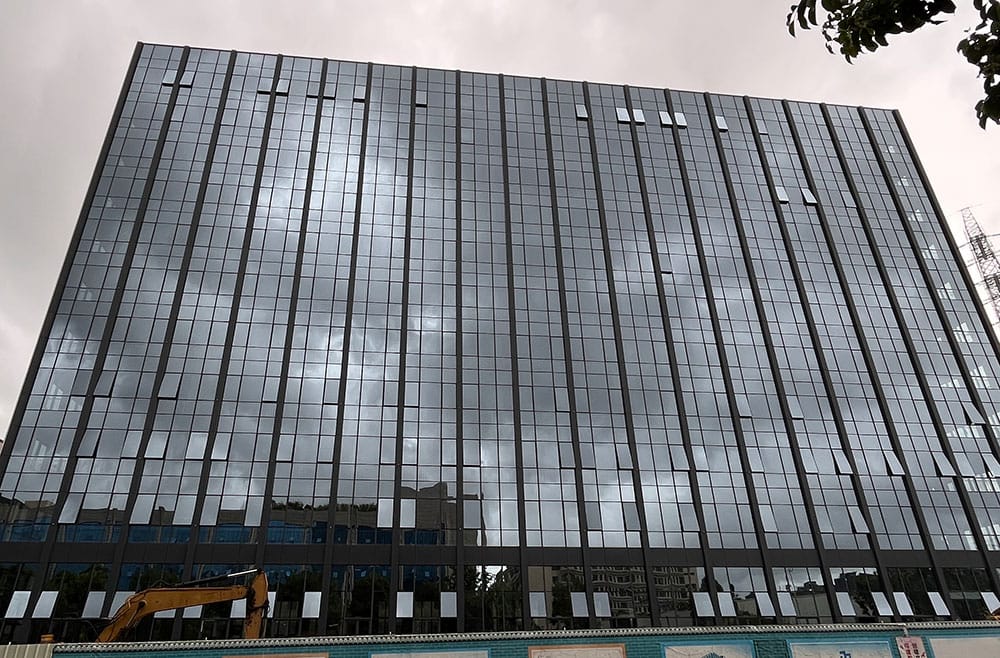
Transparency is the most intuitive aesthetic advantage of glass curtain walls. It breaks the heaviness of traditional walls, giving buildings a lightweight and open appearance. Especially in urban core areas, glass curtain walls reflect the sky, streets, and surrounding buildings, achieving visual integration between the building and its environment.
As light changes, the appearance of glass curtain walls also presents dynamic effects: warm morning light endows the building with a soft texture, midday sun highlights its sleek modernity, and indoor lights shining through at night create a warm urban night scene. This “changeable building skin” makes glass curtain walls a key tool for shaping a building’s unique identity, helping projects enhance brand image and landmark value.
(2) Efficient Functional Features Improve User Experience
Beyond aesthetics, the functional advantages of glass curtain walls are equally notable.
1. Optimized natural lighting: Large-area glass allows ample natural light indoors, reducing reliance on artificial lighting. This not only lowers energy consumption but also improves space comfort. Studies show that office environments with sufficient natural light can increase employee productivity by over 15%.
2. Thermal insulation performance: Curtain wall systems using double-pane insulated Low-E glass can achieve a heat transfer coefficient of less than 1.8 W/(㎡·K), saving over 30% more energy than traditional walls. This effectively reduces air conditioning and heating loads, especially in cold or tropical regions.
3. Sound insulation effect: Composite glass structures block external noise effectively. In buildings along busy urban roads, glass curtain walls can control indoor noise below 40 decibels, meeting the quiet needs of office and residential spaces.
(3) Dual Benefits in Construction and Economy
From a project management perspective, glass curtain walls offer significant construction advantages.
Their main components are prefabricated in factories, and only on-site assembly is required. This shortens the construction period by 20%–30% compared to traditional curtain walls, making them suitable for large-scale projects with tight schedules.
Factory production ensures component precision, reduces on-site construction errors, and improves project quality.
In terms of long-term maintenance, cleaning and inspection of glass curtain walls can be conducted using professional equipment. High-quality sealants and hardware have a service life of 15–20 years, keeping long-term maintenance costs relatively manageable. These features are highly attractive to international clients seeking efficient construction and long-term cost-effectiveness.
3. Application Fields of Glass Curtain Walls: Comprehensive Demonstration of Scenario Adaptability
The advantages of glass curtain walls enable them to play important roles in various building types. Their application scenarios continue to expand, from commercial spaces to public buildings, office towers to high-end residences.
(1) Commercial Buildings: Visual Focus for Attracting Customers
Commercial buildings such as shopping malls have high requirements for exterior appeal. Glass curtain walls attract pedestrians’ attention through their transparent display surfaces, enhancing commercial vitality. For example, Singapore’s Marina Bay Sands Shopping Mall uses large-area glass curtain walls to create interaction between indoor stores and outdoor landscapes, making it a popular spot for tourists and consumers.
Meanwhile, the natural lighting provided by glass curtain walls brightens the mall interior, creating a comfortable shopping environment and indirectly boosting consumption conversion.
(2) Office Buildings: Shaping a Modern Corporate Image
Office buildings are one of the main application scenarios for glass curtain walls. Transparent glass curtain walls not only provide sufficient natural light for office workers but also showcase a company’s open and professional image. For instance, London’s The Shard adopts a gradient glass curtain wall design, which meets the lighting needs of office spaces and has become a landmark of London’s Financial City, attracting many international enterprises to settle in.
For multinational companies that value brand image, office buildings with glass curtain walls are important carriers for enhancing corporate influence.
(3) Public Buildings and High-End Residences: Upgrading Functionality and Quality
Public buildings such as exhibition halls and libraries need to balance lighting and spatial openness—glass curtain walls meet this need perfectly. For example, the glass curtain wall design of the China National Pavilion at the Shanghai World Expo ensures natural lighting in the exhibition halls while embodying the architectural concept of “Crown of the East.”
In the high-end residential sector, glass curtain walls provide residents with broad views and transparent living spaces. Especially in areas with superior landscapes such as coastal regions and mountainous areas, residential buildings with glass curtain walls have become a key choice for improving living quality.4. Limitations of Glass Curtain Walls: Rational Cognition and Risk Mitigation
Despite their significant advantages, the limitations of glass curtain walls require the attention of international clients in practical applications. Only by fully recognizing these issues and taking targeted measures can glass curtain walls be used reasonably.
(1) Light Pollution: A Challenge to Environment and Safety
The specular reflection of glass curtain walls may cause light pollution. Especially at noon in summer, intense reflected light can cause visual disturbance to pedestrians and even affect traffic safety. Additionally, light pollution may disrupt the growth cycles of surrounding plants.
To address this issue, low-reflectivity glass (with a reflectivity below 15%) or asymmetric curtain wall designs can be used to reduce concentrated reflection and minimize environmental impact.
(2) Safety Hazards: Risks of Spontaneous Breakage and Falling
Tempered glass has a spontaneous breakage rate of approximately 0.3%, mainly caused by the expansion of nickel sulfide impurities inside the glass. If a curtain wall glass breaks spontaneously and is not replaced promptly, it may fall and cause safety accidents.
To mitigate this risk, laminated tempered glass is recommended. Even if the glass breaks, the interlayer will hold the fragments in place to prevent falling. Meanwhile, a regular inspection system should be established: comprehensive inspections of curtain walls used for over 10 years should be conducted, and aging components should be replaced in a timely manner.
(3) Weak Fire Resistance: A Shortcoming in Fire Safety
Ordinary glass is prone to breaking at high temperatures. If the vertical fire compartments of glass curtain walls are improperly handled, they may become channels for fire spread.
In response, fireproof rock wool barriers and fire-resistant glass should be installed in curtain wall designs to effectively block the spread of fire and smoke in case of a fire. At the same time, designs and constructions must strictly comply with local fire codes.
(4) Maintenance Costs and Difficulty: Considerations for Long-Term Management
The maintenance cost of glass curtain walls is relatively high. In particular, cleaning glass on high-rise buildings requires professional high-altitude operation equipment, resulting in high expenses. Additionally, the aging of sealants can cause water leakage in curtain walls, requiring regular replacement of sealants (usually every 10–15 years).
For international clients, long-term maintenance costs should be included in the budget during the project planning stage. Selecting high-quality curtain wall system suppliers can also reduce long-term maintenance difficulties.
5. Conclusion and Call to Action
In summary, glass curtain walls have distinct advantages and disadvantages. They are an excellent choice for shaping architectural aesthetics and improving functional experiences, but they also have limitations such as light pollution and safety hazards. For global construction projects, the key lies in making reasonable designs and selections based on project positioning, regional environment, and functional needs, and using technical means to mitigate risks to achieve a balance between aesthetics and practicality.
If you are seeking reliable curtain wall solutions for your international construction project, we have 20 years of experience in global curtain wall projects. We can provide customized design and technical support according to your specific needs, ensuring the safety, energy efficiency, and aesthetics of the curtain wall system throughout the process—from material selection to construction management. Contact us now and let our professional team create a high-quality and valuable glass curtain wall solution for your project.

