
In modern architectural design, curtain walls are not only a critical part of the building envelope but also a defining element of a building’s overall image, quality, and value. As a result, “How much does a curtain wall cost per square meter?” is one of the most important cost-related questions for owners and developers during the early planning stage of a project.
The cost of a curtain wall is not a fixed number. It is a comprehensive result influenced by multiple interrelated factors. Only by understanding these variables can informed decisions be made that balance budget control with performance and aesthetic requirements. Below, we break down the key components that determine curtain wall pricing.
1. Structural Materials: The Cost Foundation
The primary load-bearing structure of a curtain wall—including mullions and transoms—is a fundamental factor in determining the cost per square meter.
Standard Aluminum Profiles
Most curtain walls use aluminum alloys such as 6063-T5/T6. These systems are relatively economical. Key cost drivers include the global aluminum price, profile dimensions, and wall thickness (main load-bearing mullions typically require a thickness of ≥3.0 mm).
Steel or Steel-Aluminum Composite Systems
For super high-rise buildings, large spans, or complex geometries, steel frames or steel-aluminum hybrid systems may be required. While raw steel may be cheaper than aluminum, fabrication complexity, corrosion protection (hot-dip galvanizing, fluorocarbon coating), and higher installation requirements often result in a higher overall cost per square meter. Complex custom steel structures can be particularly expensive.
Special Alloy Materials
Materials such as titanium-zinc panels or copper panels are typically used in high-end architectural applications. Due to their high material cost, they have a significant impact on the overall curtain wall budget.
2. Curtain Wall Panels: From Basic to Premium
Curtain wall panels define the building’s visual appearance and are one of the largest sources of cost variation.
Transparent Glass Panels
This is the most common option. While basic float glass is inexpensive, almost all curtain wall applications require upgraded glass types:
Safety Glass (Mandatory): laminated, heat-strengthened, or fully tempered glass, with increasing cost levels.
Energy-Efficient Glass (Mainstream Choice):
Single-silver Low-E
Double-silver Low-E
Triple-silver Low-E
Higher silver content provides better thermal performance and significantly higher cost. High-end triple-silver Low-E glass can cost more than 1.5 times that of double-silver glass.
Specialty Glass: ultra-clear (low-iron) glass, fire-rated glass, and other functional glass types can substantially increase the price.
Opaque Panels
Aluminum Panels / Aluminum Composite Panels
Widely used due to good formability and moderate cost. Pricing depends on panel thickness (typically 2.0–4.0 mm), surface coating (polyester vs. fluorocarbon), panel size, backing requirements, and complexity of fabrication.
Stone Panels (Granite, Marble, etc.)
Natural stone is relatively expensive, especially premium or imported varieties. Factors such as thickness (usually 25–30 mm), anchoring systems (e.g., back-bolt fixing), and installation complexity significantly influence cost.
Terracotta Panels and Specialty Metal Panels
These high-performance architectural materials are generally used in premium projects and come at a higher unit cost.
Unitized Curtain Wall Panels
In unitized systems, panels and frames are preassembled in factories. Material and fabrication costs are highly integrated within the manufacturing process.
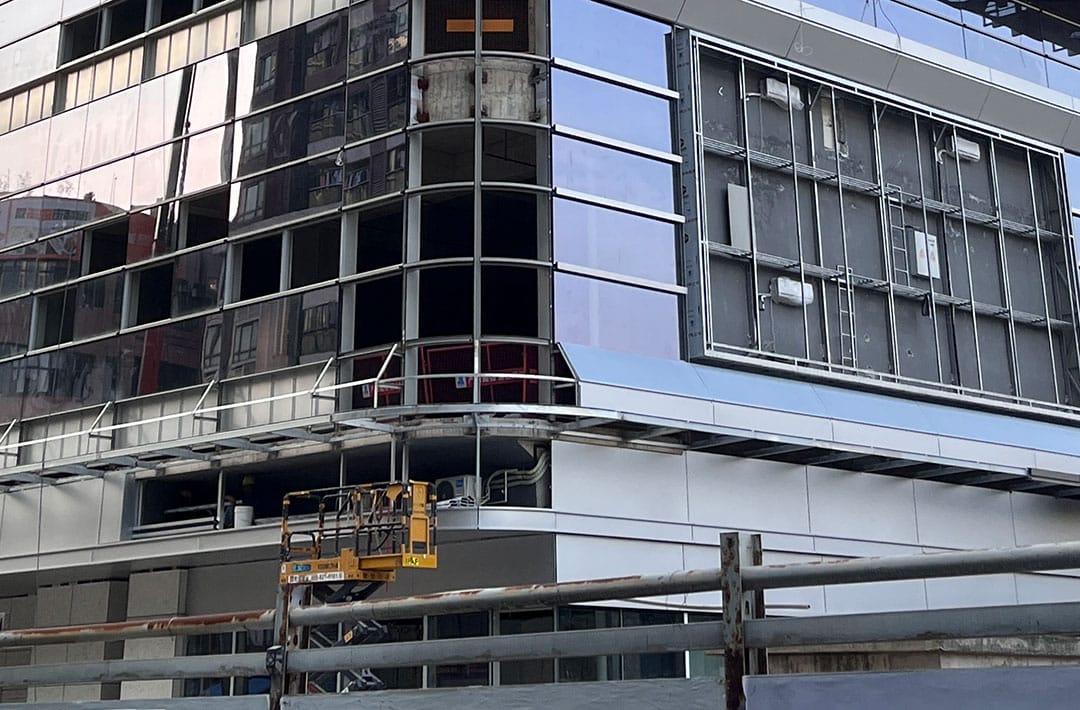
3. System Type and Structural Complexity
The curtain wall system and construction method have a major impact on overall cost.
Stick System Curtain Wall
The most economical and widely used option for low- to mid-rise buildings. It offers flexible installation and efficient material usage.
Semi-Unitized System
Partially prefabricated, offering improved efficiency over stick systems at a moderate increase in cost.
Fully Unitized System
The most industrialized and efficient system, with superior quality control and shortened site installation time. However, higher upfront design, manufacturing, transportation, and lifting costs typically make it 1.5 times or more expensive than stick systems. It is best suited for high-rise or fast-track projects.
Special Systems
Point-supported glass walls, all-glass façades, cable-supported or tensile structures require highly specialized engineering, precision fabrication, and custom stainless steel components. These systems are significantly more expensive and highly project-specific.
4. Project Scale and Execution Factors
Curtain wall pricing extends far beyond material costs alone—it is a highly complex engineering system.
Design and Engineering Costs: concept design, structural analysis, shop drawings, and fabrication detailing.
Project Size and Schedule: larger projects can dilute management costs per square meter, while extended schedules increase overhead and labor risks. Fast-track projects incur premium costs.
Location and Site Conditions: transportation distance, seismic or wind-load requirements, installation height, limited site access, and retrofit conditions all influence pricing.
Quality and Management Standards: contractor expertise, inspection frequency, workmanship precision, and acceptance standards directly affect cost.
5. Reference Price Ranges in the Current Market (China)
The following ranges are indicative only. Actual pricing must be calculated on a project-specific basis.
Stick System Glass Curtain Wall
Basic configuration (6+12A+6 insulated tempered glass, standard aluminum):
RMB 850 – 1,200 / m²
Energy-efficient configuration (double-silver Low-E):
RMB 1,200 – 1,600 / m²
High-performance configuration (triple-silver Low-E or laminated IGU):
RMB 1,600 – 2,300 / m²
Unitized Glass Curtain Wall
Basic: RMB 1,600 – 2,100 / m²
Mid-to-high end: RMB 2,100 – 3,000 / m²
Premium systems: RMB 3,000 / m² and above
Aluminum Panel Curtain Wall
Standard fluorocarbon-coated aluminum panels (2.5–3.0 mm):
RMB 900 – 1,300 / m²
Complex curved or perforated panels are significantly more expensive.
Stone Curtain Wall
Standard granite (dry-hung): RMB 1,500 – 2,300 / m²
Premium marble or specialty stone: RMB 2,400 – 4,000 / m² and above
Mixed Curtain Wall Systems
Prices vary widely depending on material ratios and complexity, typically ranging from RMB 1,500 – 2,500 / m².
It must be emphasized that “the cost per square meter of a curtain wall” cannot be accurately determined through online references or brief discussions. A reliable cost estimate requires detailed technical analysis, design optimization, site inspection, quantity takeoff, and professional cost evaluation by experienced curtain wall consultants or contractors.
A rigorous and comprehensive budget report is essential for effective cost control throughout the project lifecycle.
From early-stage cost planning and system optimization to construction-phase cost control and long-term maintenance support, we are committed to delivering end-to-end value across the entire curtain wall system. Our goal is to ensure that every square meter of investment delivers measurable performance, aesthetic quality, and long-term value—supported by professional expertise, transparency, and reliable execution.

