
When selecting glass curtain wall suppliers for projects in Africa, it is crucial to ensure the quality, compliance, and construction safety of the project’s facade. As an expert with 20 years of experience in the curtain wall industry, ZDMQ will provide a comprehensive overview of the African market environment, selection recommendations, and several reputable suppliers. This guide aims to help African developers, contractors, and property owners form a clear roadmap for “finding curtain wall partners.”
1. African Construction Market and Glass Curtain Wall Trends
1.1 Characteristics of the African Market
Most African countries are developing nations with rapid urbanization, leading to a growing number of new commercial buildings, hotels, complexes, and government/public facilities.
Diverse climates—from equatorial tropics and semi-arid regions to the Mediterranean coast—require curtain wall systems to be locally adaptable in terms of wind resistance, thermal insulation, heat preservation, and waterproofing.
Inadequate infrastructure and logistics support place higher demands on suppliers’ local support, construction service capabilities, and after-sales guarantees.
Local regulations, standards, and testing mechanisms may be less sophisticated than those in Europe and the United States. Choosing suppliers with international certifications and rich engineering experience is therefore safer.
1.2 Value of Glass Curtain Walls in Africa
Glass curtain walls feature a modern, transparent design, making them ideal for office buildings, high-end hotels, and landmark projects.
Properly selected systems enhance natural lighting, reduce energy consumption for lighting and air conditioning, and support green building and sustainable design.
High-quality curtain wall systems improve building grade, rental value, and user experience.
Note: Improper selection or construction can lead to water leakage, thermal bridges, glass breakage, structural aging, and other issues, resulting in high maintenance costs.
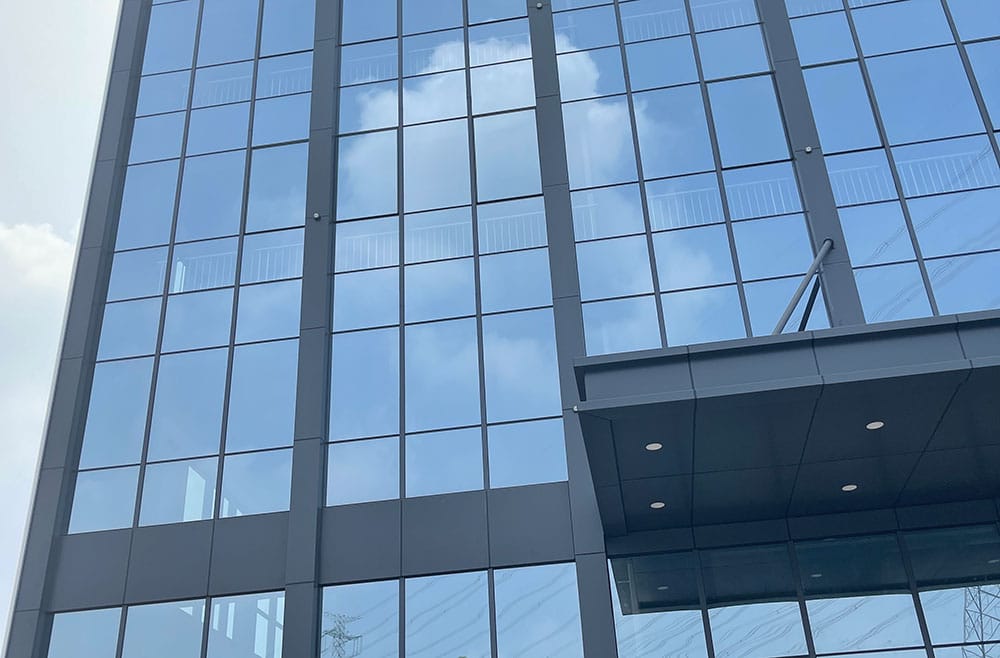
1.3 Key Factors for Selecting Glass Curtain Wall Suppliers
To ensure project success, the following factors are particularly important:
Design and engineering capabilities: Suppliers should provide full-process services, including curtain wall system design, structural calculation, wind load analysis, and thermal performance simulation.
Local experience and project cases: Successful experience in Africa or similar climatic conditions is highly advantageous.
Material and system performance: This includes aluminum profiles, waterproof seals, glass specifications (e.g., low-emissivity glass, laminated glass, fire-resistant glass), thermal bridge treatment, and wind resistance.
Supply chain and logistics capabilities: Timely supply of profiles, glass, hardware, and on-site construction support. Guarantees for port transportation, customs clearance, and local installation in Africa are essential.
On-site construction and after-sales service: Installation quality directly affects curtain wall lifespan. Suppliers or their cooperative installers must have competent construction teams and localized service capabilities.
Certification and standard compliance: Curtain wall systems must meet local or international standards for air tightness, water tightness, wind resistance, and structural safety.
Cost and schedule control: African projects face high risks of construction delays and cost overruns. Suppliers should demonstrate strong project management capabilities.
After clarifying these factors, we introduce several reputable suppliers with a presence in Africa or the capability to enter the market.
2. How to Identify “Reliable” Glass Curtain Wall Suppliers for African Projects
Based on years of industry experience, the following screening process helps determine if a glass curtain wall supplier is truly reliable for African projects:
2.1 Verify Qualifications and Experience
Request test reports for the curtain wall system’s wind pressure resistance, air tightness, water tightness, and thermal performance.
Review project cases in similar climates/environments (e.g., tropical regions, coastal areas, high-wind zones, dusty areas).
Confirm the supplier’s EPC (Engineering, Procurement, Construction) capabilities—from design, manufacturing, glass matching, and installation to after-sales service—or at least their ability to coordinate comprehensive services.
Understand their cooperation mechanism with local construction/installation teams—whether they offer localized services and rapid response capabilities.
2.2 Align Project Positioning with Technical Requirements
Select curtain wall systems of corresponding technical grades based on project height (low-rise, mid-rise, high-rise), whether it is a landmark building, and if it has special designs.
For buildings in coastal or high-wind zones (e.g., African coastlines), confirm the curtain wall system’s wind resistance, corrosion-resistant aluminum grade, and whether the sealing structure is suitable.
Choose glass configurations (e.g., low-emissivity glass, laminated safety glass, insulated glass) based on local solar radiation intensity and heat gain requirements in Africa.
Consider risks related to African ports, customs clearance, and transportation when planning logistics and installation timelines. Suppliers should provide detailed production, transportation, and installation coordination plans.
2.3 Evaluate Localized Service and After-Sales Support
A reliable supplier should have established or cooperative installation and on-site commissioning teams in Africa.
Clarify warranty terms, construction quality acceptance standards, and post-maintenance response mechanisms in the contract.
Plan for long-term operation and maintenance (cleaning, glass replacement, seal repair, etc.), as these are critical for glass curtain wall projects.
Check if the supplier can provide local spare parts and has trained local construction/maintenance teams.
2.4 Control Costs, Schedules, and Risks
Cost control is particularly critical for African projects. Confirm with the supplier whether the price includes transportation, customs clearance, installation, and commissioning fees.
Verify the construction schedule, ensuring it accounts for local rainy seasons, logistics delays, and labor arrangements.
Request risk-sharing clauses from the supplier: measures for glass breakage, compensation for delays, and handling of construction period changes.
Include milestone payments, acceptance checkpoints, and on-site quality standards in the contract to mitigate risks.
2.5 Ensure Compliance and Certification
Although building standards in many African countries are still evolving, choosing curtain wall systems with international certifications (e.g., ISO, CE) or local South African certifications is more reliable.
For projects involving international financing, factors such as energy efficiency, green materials, and recyclability of the curtain wall system are particularly important.
Request suppliers to provide raw material source declarations and environmental and traceability documents for aluminum and glass.
3. Summary and Recommendations
For selecting glass curtain wall systems for African construction projects, we summarize the following recommendations:
1. Prioritize suppliers with proven experience: Many African building curtain walls are completed by Chinese enterprises, which are more familiar with the African market’s needs and construction environments.
2. Choose Chinese curtain wall systems if budget allows: They offer a more international facade appearance and superior system performance.
3. Clarify project requirements, climatic conditions, and maintenance cycles: Focus not only on appearance but also on whether the curtain wall system is truly adaptable to the country’s climate, coastal, or dusty environments.
4. Attach great importance to installation and after-sales service capabilities: A high-quality system can fail without proper installation.
5. Ensure detailed contracts and technical documents: Include performance indicators, warranty terms, delivery schedules, payment milestones, and risk-sharing clauses.
6. Plan maintenance costs in advance: Curtain walls require long-term investment in cleaning, replacement, and seal repair—estimate these costs upfront.
7. Treat “glass curtain wall suppliers” as project partners: Rather than just material vendors. The right partner can reduce construction risks, lower long-term operation and maintenance costs, and improve building quality.
If you are focusing on the core question of “reliable glass curtain wall suppliers in Africa” and seeking a cost-effective one-stop solution with professional strength, we sincerely recommend contacting ZDMQ, an experienced curtain wall expert. Their extensive glass curtain wall project experience helps balance budget and quality precisely. They can also send material samples in advance to let you experience the detailed quality firsthand, supporting the success of your key curtain wall projects.

