
I.Introduction
Amid the global development of high-rise and super high-rise buildings, the design and construction technologies of curtain wall systems continue to evolve. As one of the most important forms of contemporary building facades, the Unitized Curtain Wall has become a widely adopted curtain wall solution in international engineering projects, thanks to its efficient factory production, rapid installation, and excellent performance.
However, every system has its pros and cons. To help international owners and developers make more informed decisions during the scheme selection stage, this article systematically analyzes the advantages and disadvantages of unitized curtain walls. Combining practical engineering experience, it provides clear and practical references from technical, cost, maintenance, and sustainability perspectives.
II. Definition and Characteristics of Unitized Curtain Walls
A unitized curtain wall is a curtain wall system where curtain wall components (including glass panels, aluminum frames, sealing systems, etc.) are pre-assembled into complete units in a factory and then transported to the construction site for overall hoisting.
Different from traditional “stick curtain walls,” the unitized system does not require on-site assembly piece by piece. Instead, it is directly spliced in a modular manner, significantly improving installation speed and quality control standards.
Its core characteristics include:
1. High degree of factory prefabrication;
2. Rapid on-site installation, mainly dry work;
3. Excellent airtightness and watertightness;
4. Suitable for high-rise, super high-rise, and large complex building facades.
III. Main Advantages of Unitized Curtain Walls
1. Efficient Construction Period Control
The biggest advantage of unitized curtain walls is that production and installation can be carried out in parallel.
Curtain wall units are mass-produced in the factory while the main structure is constructed simultaneously;
Hoisting of curtain wall units can start immediately after the structure is completed to a certain number of floors;
Tens to hundreds of square meters of facades can be installed per day, greatly shortening the construction period.
This high efficiency is particularly important for projects pursuing rapid delivery, such as commercial complexes, hotels, or office buildings.
2. Superior Quality and Performance Control
Prefabrication completed in a controlled factory environment allows strict implementation of ISO quality system standards, avoiding the impact of on-site conditions (dust, humidity, temperature) on gluing and assembly accuracy.
Factory assembly ensures:
High precision of joints;
Complete sealing system;
Clean and pollution-free glass surfaces;
Stable curing conditions for structural adhesives.
Therefore, unitized curtain walls are generally superior to stick curtain walls in terms of airtightness, watertightness, and wind load resistance.
3. Safer Installation Process
In high-rise building construction, safety is the primary consideration. Unitized systems adopt internal-external hoisting or rail hoisting methods, with most operations carried out indoors, reducing the risk of workers working at height outside. At the same time, the joints between units are automatically locked through designed positioning parts, ensuring high installation accuracy and strong safety.
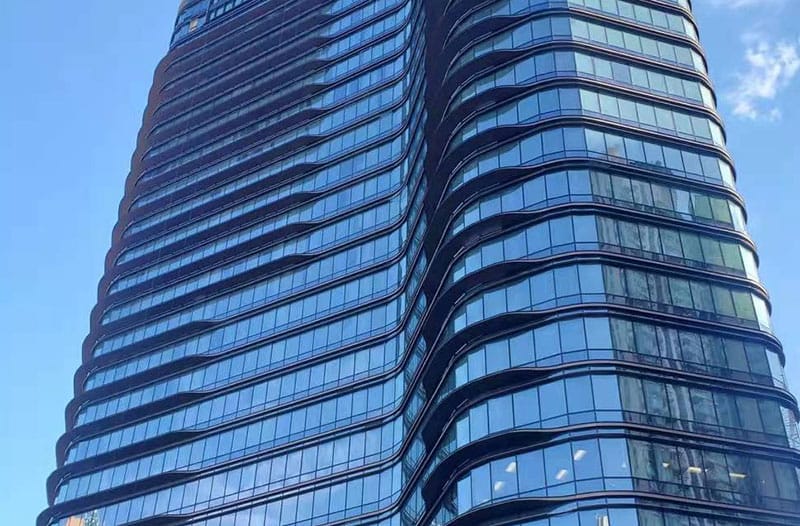
4. Consistent Appearance and Aesthetic Effect
Since all units are uniformly produced in the factory, the color, reflectivity of glass, and color difference control of metal components are more precise. Large facades present a highly consistent visual effect, meeting the requirements of modern buildings for aesthetics and refinement.
In addition, the facade lines of unitized curtain walls can be flexibly adjusted according to the design to achieve flat, sloped, corner, or even double-curved shapes.
5. Adaptability to Complex Climates and Structural Displacements
Unitized systems reserve space for structural displacement and temperature expansion/contraction in the design. The connection nodes between each unit can absorb horizontal and vertical displacements, maintaining the overall airtightness and waterproof performance of the curtain wall. It is particularly suitable for seismic zones, strong wind areas, or regions with complex climates.
IV. Main Disadvantages of Unitized Curtain Walls
1. High Initial Investment Cost
Unitized curtain walls have high requirements for design, mold making, and factory equipment investment. High prefabrication precision, strict requirements for transportation and hoisting equipment result in a significantly higher initial cost than traditional stick curtain walls.
However, from a life-cycle cost perspective, due to lower maintenance frequency and good energy consumption control, its long-term operating cost is usually lower.
2. Difficult Transportation and Hoisting
Each unit is large in size and heavy (usually 200–400 kg per unit), requiring high standards for protection, loading/unloading, and storage space during transportation. At high-rise building construction sites, hoisting channels must be reasonably planned; otherwise, it is prone to construction delays or damage risks.
3. Long Design and Manufacturing Cycle
Due to the complex system, each project requires customized design, including node details, mold making, and prototype testing. Insufficient early coordination can easily affect the overall progress. For projects with tight schedules, the design preparation cycle of unitized curtain walls may become a bottleneck.
4. Difficult Maintenance and Replacement
Panel replacement of unitized curtain walls usually requires overall removal of the unit instead of replacing a single glass panel. This means maintenance requires hoisting equipment and professional personnel, resulting in high costs. Therefore, system stability and quality control in the early stage of the project are particularly critical.
5. High Requirements for Curtain Wall Consultants and Construction Teams
The successful implementation of this system relies on highly coordinated design, production, and construction management capabilities. Inexperienced teams may lead to assembly deviations, joint mismatches, or drainage system failures. International owners should prioritize professional companies with mature unitized curtain wall experience when selecting contractors.
V. Sustainable Development and Future Trends of Unitized Curtain Walls
1. Integration with Green Building Technologies
With the advancement of global carbon emission targets, unitized curtain walls are constantly integrating with energy-saving systems, such as:
Insulated double-silver or triple-silver Low-E glass;
Integrated sunshade louvers and intelligent ventilation systems;
Modular integration of Building-Integrated Photovoltaics (BIPV).
These innovations transform the curtain wall from an “exterior skin” to an “energy management system,” significantly improving the energy efficiency of buildings.
2. Intelligent and Digital Design
Through technologies such as BIM (Building Information Modeling) and Digital Twin, precise 3D modeling and collision detection of curtain walls can be achieved during the design stage. Data from the installation and maintenance stages can be traced and managed, making the life cycle of unitized curtain walls more controllable and efficient.
3. Factory Automation and Robotic Assembly
Future curtain wall factories will adopt robotic arms, automatic gluing, and testing systems to ensure consistent precision and error-free assembly of each unit. This trend not only improves quality but also significantly reduces human risks.
VI. How to Select a Suitable Curtain Wall System
For international developers, selecting a suitable curtain wall system should be based on the following factors:
1. Building type and height: Unitized systems are recommended for high-rise buildings and complex shapes;
2. Project cycle and delivery requirements: Unitized systems have obvious advantages if rapid delivery is needed;
3. Budget and life-cycle cost: High initial investment but low long-term maintenance cost;
4. Construction conditions: Hoisting equipment, transportation conditions, and site constraints need to be evaluated in advance;
5. Maintenance strategy: A complete curtain wall maintenance manual and regular inspection plan should be established.
Only after fully considering the above factors can unitized curtain walls maximize their value and achieve a balance between performance, aesthetics, and economy.
Unitized curtain walls are an important achievement in the development of modern building curtain wall technology, representing the trend of industrialization, standardization, and high performance. With excellent airtightness, watertightness, and installation efficiency, they have become the preferred solution for high-end construction projects.
However, system complexity and high costs also require developers to conduct sufficient planning in the early design stage and select experienced curtain wall consultants and manufacturers.
For international clients pursuing quality, efficiency, and sustainable development, correctly understanding and applying the advantages and disadvantages of unitized curtain walls can not only ensure the safety and aesthetics of the building but also gain higher asset value and brand reputation in long-term operations.

