
— A 20-Year Façade Expert’s Guide to Global Building Maintenance Costs and Decision Strategies
1. Introduction: Why Curtain Wall Repair and Replacement Matter
As global urbanization accelerates, modern buildings increasingly adopt curtain wall systems made of glass, aluminum panels, or stone. These façades give buildings their distinctive appearance and high-performance envelope. However, over time, factors such as environmental exposure, material aging, or design defects can lead to issues like water leakage, detachment, sealant failure, or structural loosening.
At this stage, curtain wall repair or replacement becomes an essential part of building operation, safety management, and asset preservation.
For many owners, architects, and facility managers, the most common question is:
“How much does curtain wall repair or replacement cost?”
While the question seems simple, the answer depends on a wide range of factors—including system type, damage scope, material specifications, construction difficulty, and regional market variations.
This article analyzes the core logic behind “how much curtain wall repair or replacement costs” from multiple angles—cost, installation methods, performance, and application scenarios—and concludes with expert recommendations.
2. Key Factors Affecting Curtain Wall Repair and Replacement Cost
1. Type of Curtain Wall System
Different systems vary in structural complexity, repair methods, and associated costs:
Stick System: Simple structure, easy to repair, relatively low cost.
Unitized System: High level of prefabrication; repair usually requires removing and reinstalling full panels, leading to higher labor and equipment costs.
Point-Supported Glass System: Extremely precise tolerances; disassembly and reinstallation are complex and costly.
Stone Curtain Wall: Often requires structural reinforcement and re-anchoring—highly labor-intensive.
2. Material Costs
The prices of glass, aluminum, or stone panels vary significantly by specification:
Standard Insulated Glass: approx. US$40–100/m²
Low-E Energy-Efficient Glass: approx. US$100–200/m²
Special Safety Glass (laminated, blast-resistant): approx. US$200–400/m²
Aluminum Panels: Prices depend on thickness, coating type, and color customization.
In practice, material costs include not only the panels but also support systems, sealants, anchors, and fixings, all of which add to the total.
3. Building Height and Site Conditions
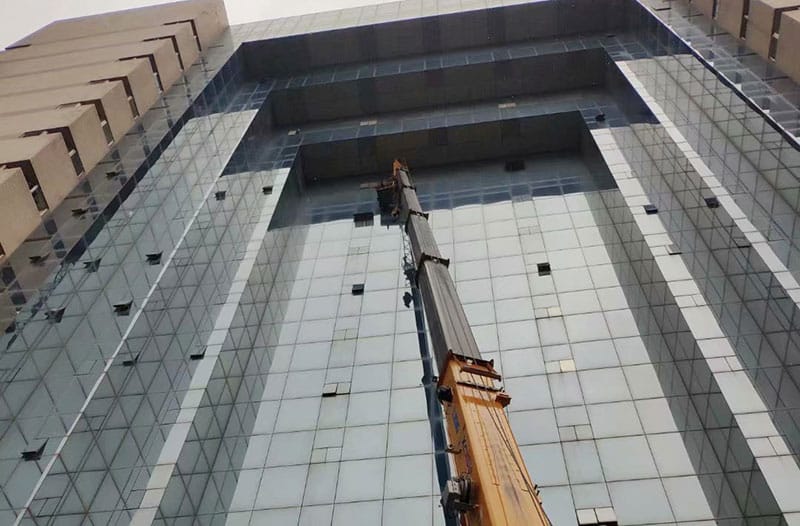
High-rise and supertall buildings require gondolas, cranes, or scaffolding, dramatically increasing labor and equipment costs.
Urban projects often face nighttime construction, limited traffic access, and noise restrictions.
Sites exposed to strong wind loads (e.g., coastal or plateau regions) demand higher safety measures and complex procedures.
4. Performance and Design Requirements
If repair or replacement involves performance upgrades—such as improving air-tightness, water-tightness, or insulation—the cost will rise due to thicker glass, improved profiles, and thermal breaks.
5. Regional Differences
Labor, material, transport, and tax costs vary widely across regions:
In Southeast Asia, curtain wall repair/replacement costs are typically 50–70% of those in Europe or North America.
In the Middle East, prices are higher due to energy efficiency and heat resistance requirements.
In Europe and North America, stringent safety and environmental standards make labor the dominant cost driver.
3. Installation Methods for Curtain Wall Repair or Replacement
The chosen installation method directly affects total cost, construction period, and safety risk.
1. Suspended Gondola Access
Suitable for high-rise or localized repair.
Flexible and cost-effective.
However, efficiency depends on weather and site accessibility.
2. Scaffolding Installation
Best for low-rise buildings or large-scale replacement.
High safety level but with additional setup and dismantling costs.
3. Unitized Panel Replacement via Crane Installation
Used for modern high-rise façades.
Prefabricated units ensure precision but require cranes and alignment adjustment, increasing costs.
4. Interior Access or Reverse-Hanging Installation
Suitable for buildings where external access is restricted.
Technically demanding and requires specialized equipment.
Choosing the right method means finding a balance among safety, cost, and schedule.
4. Performance Considerations During Repair or Replacement
When repairing or replacing curtain walls, cost is only part of the equation—restoring or enhancing performance is equally critical:
Air and Water Tightness: Resealing or replacing gaskets can eliminate leakage problems.
Structural Safety: Includes inspection and reinforcement of brackets, anchors, and fasteners.
Energy Efficiency: Upgrading to Low-E or insulated glass can significantly reduce energy consumption.
Acoustic and Thermal Insulation: Important for office buildings, hotels, and facilities near busy roads or airports.
Fire Protection: Fire-rated glass or fire-stop systems may be required under local building codes.
5. Typical Application Scenarios and Cost References
1. Office Building Façade Renovation
Purpose: Enhance building appearance, energy efficiency, and leasing value.
Features: Partial glass replacement, resealing, or aluminum panel repainting.
Cost: approx. US$150–350/m²
2. Hotels and Commercial Complexes
Purpose: Fix leakage, aging sealants, or broken glass.
Features: Must be performed while the facility remains operational; noise and safety constraints are strict.
Cost: approx. US$200–400/m²
3. High-Rise Residential or Tower Maintenance
Purpose: Prevent glass detachment, improve wind resistance.
Features: High-altitude work via gondola; complex safety measures.
Cost: approx. US$250–600/m²
4. Special Structures (Airports, Convention Centers, Stadiums)
Purpose: Replace large point-supported glass panels or complex façade geometries.
Features: Technically demanding, long fabrication cycles.
Cost: up to US$800–1,200/m²
6. Expert Recommendations: Optimizing Curtain Wall Repair and Replacement
Drawing from over 20 years of façade engineering experience, here are practical insights for managing cost and quality:
Inspect Before Deciding.
Conduct professional façade assessments to identify root causes (structural, sealing, drainage, anchorage) before determining whether full replacement is needed.
Prioritize Partial Replacement.
If the damage is localized, consider sectional repairs or resealing to avoid unnecessary large-scale refurbishment.
Use Original or Certified Components.
Always use original brand sealants, gaskets, and connectors to ensure long-term durability.
Balance Safety and Construction Efficiency.
Façade repair is often high-altitude work—ensure the contractor has proper qualifications and safety certifications.
Consider Lifecycle Costs.
Evaluate not only the upfront cost but also future maintenance cycles and energy savings.
Keep Detailed Records.
Maintain documentation of inspections, repair reports, and warranties for future reference.
7. Conclusion
The question “How much does curtain wall repair or replacement cost?” has no single answer—it depends on the system type, materials, performance requirements, construction conditions, and regional cost factors.
Generally, glass curtain wall repair and replacement costs range from US$150–500 per square meter, while complex systems can reach up to US$1,000/m².
Ultimately, a well-planned repair strategy—based on accurate diagnosis, professional engineering, and compliant execution—provides far greater long-term value and safety assurance than simply choosing the lowest price.
Would you like me to format this into a professional white paper layout (with executive summary, infographics suggestions, and ready-for-publication formatting for an architecture or property management journal)?

