
A curtain wall system not only defines a building’s aesthetic style but also significantly impacts construction costs, long-term operation and maintenance, and energy efficiency. ZDMQ serves global construction projects by analyzing the price differences, influencing factors, applicable scenarios, and selection recommendations between hidden-frame and exposed-frame curtain walls. This helps international clients make informed, cost-effective decisions when seeking reliable curtain wall solutions.
1. Definitions and Technical Differences
1.1 Exposed-Frame Curtain Walls
An exposed-frame curtain wall features clearly visible aluminum profiles or steel structural frames on the exterior facade. Horizontal beams and vertical columns form a distinct grid structure, with glass panels inserted into this framework. The system—comprising profiles, glass, and a sealing system—serves as the building’s non-load-bearing external wall. It boasts mature manufacturing technology and easy installation.
According to industry sources, exposed-frame curtain walls are also referred to as “visible-frame curtain walls.”
1.2 Hidden-Frame Curtain Walls
Hidden-frame curtain walls conceal load-bearing or supporting profiles behind glass panels, resulting in an exterior with almost no visible horizontal or vertical frames. This creates a “full-glass” or “nearly grid-free” visual effect. A typical design involves fixing glass panels directly to a concealed support system, often using structural adhesives. The system offers a sleek, modern appearance and strong visual continuity.
1.3 Why Distinguish Between “Hidden” and “Exposed” Frames?
From the perspectives of performance and cost, hidden-frame and exposed-frame systems differ not only in aesthetics but also in structure, materials, construction processes, and maintenance methods. These differences ultimately manifest in their prices—a focus of this article.
2. Global Curtain Wall Cost Overview
Before diving into the price comparison between hidden-frame and exposed-frame systems, it is essential to understand the global reference range for overall curtain wall costs. This context helps contextualize the price fluctuations of different systems.
Authoritative sources indicate that the cost of standard curtain wall systems (glass + aluminum profiles, conventional structure) ranges from approximately25–150 USD per square foot (equivalent to 270–1,650 USD per square meter). Specific costs depend on factors such as system type, glass type, construction height, and labor conditions.
When measured per square meter:
Typical systems cost around 75–200 USD/m².
Customized or high-end systems may range from 118–400 USD/m² (or higher).
Additional sources note that high-end curtain wall window systems (though not identical to full curtain walls) can exceed 500 USD per square meter.
In summary, curtain wall costs vary widely, with significant differences driven by system type, design complexity, building height, and regional labor costs. These factors must be considered when comparing the prices of hidden-frame and exposed-frame curtain walls.
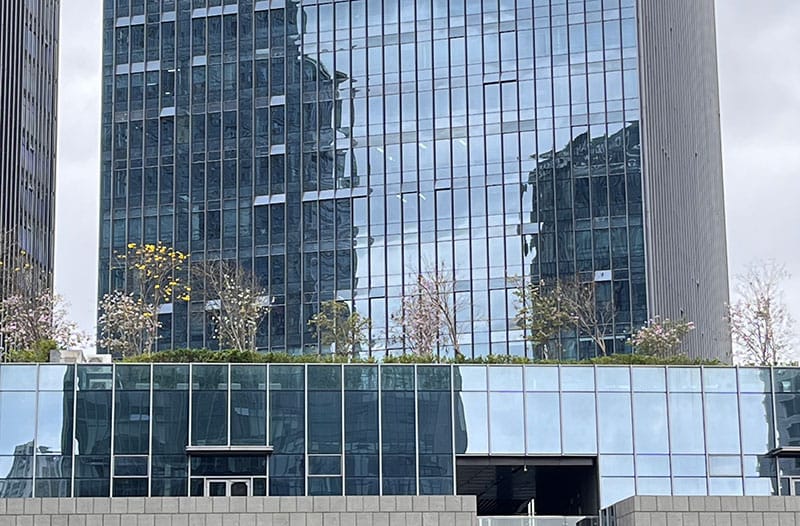
3. Price Comparison: Hidden-Frame vs. Exposed-Frame Curtain Walls
3.1 General Trend
Industry data shows that hidden-frame curtain walls typically have higher initial costs than exposed-frame alternatives. This is due to their more complex installation processes, stricter construction tolerances, higher-specification glass panels, concealed structural supports, and added value from their aesthetic appeal. For instance, one industry article states: “While hidden-frame systems may have higher upfront costs, they often outperform visible-frame systems in long-term maintenance, energy efficiency, and aesthetic value.”
Other sources highlight that hidden-frame systems—especially those using structural adhesive bonding and with no visible external aluminum frames—require more precise gluing and complex profile designs, further increasing costs compared to standard exposed-frame systems.
3.2 Quantitative Price Differences
While costs vary significantly by project, the following ranges serve as general references:
-Exposed-frame curtain walls: For conventional mid-rise/low-rise commercial or residential buildings using standard glass, aluminum profiles, and regular construction, costs typically range from80–150 USD/m² (lower or slightly higher depending on region and system specifications).
-Hidden-frame curtain walls: For systems with “nearly frameless” or ultra-thin frames (using structural adhesive bonding or point-supported designs), costs may range from120–250 USD/m² (or more). High-end projects can even exceed 300 USD/m².
It is critical to emphasize that these figures are rough estimates for budgetary reference only and should not be used as final quotation benchmarks.
3.3 Key Factors Driving Price Differences
The following factors are the primary causes of cost disparities between hidden-frame and exposed-frame systems:
(1) Glass and Panel Specifications
Hidden-frame curtain walls often require larger, thicker glass panels with fewer divisions and minimal visible structures. This may involve structural adhesive bonding and low-visibility aluminum edges—all of which increase material costs.
In contrast, exposed-frame systems use standard glass panels and conventional aluminum grids, making manufacturing and processing more economical.
High-performance glass (e.g., Low-E glass, vacuum-insulated glass, soundproof glass, explosion-proof glass) also drives up costs. Industry sources confirm that glass type is a major cost variable in curtain wall systems.
(2) Complexity of Frame/Support Systems
Hidden-frame systems require supports to be concealed behind glass, demanding higher precision during construction. Profile cross-sections may be more complex or hidden, increasing processing costs.
Exposed-frame systems have visible profiles, mature manufacturing processes, and more standardized installation.
For example, hidden-frame curtain walls may require gluing, point supports, special anchors, or precise on-site work—all of which raise installation expenses.
(3) Construction/Installation Difficulty and Labor Costs
Hidden-frame curtain walls involve concealed structures, strict tolerances, gluing processes, and high on-site precision requirements. This leads to greater construction complexity, longer timelines, higher risks, and increased labor costs.
Exposed-frame systems use standardized profiles and high modularization, enabling faster construction and lower risks.
International data shows that high-rise buildings, complex geometries, custom modules, and challenging installation environments significantly increase costs.
(4) Maintenance and Lifecycle Costs
While hidden-frame systems have higher upfront costs, they may offer long-term maintenance advantages due to their superior aesthetics, better sealing performance, and reduced need for upkeep (visible aluminum components are prone to oxidation). One source notes: “Hidden-frame systems, despite higher initial costs, may deliver greater long-term benefits.”
Exposed-frame systems have lower upfront costs but require more maintenance over time—including frequent glass or seal replacement—due to their visible aluminum parts, numerous seals, and grid divisions.
(5) Project Scale, Building Height, and Regional Differences
Costs rise with building height, number of floors, module size, and structural complexity. Hidden-frame systems are common in high-rises and landmark buildings, which demand higher construction risks and equipment standards.
Regional labor levels, transportation costs, installation equipment, and shipping/tariffs also affect final costs.
Large-scale projects using modular prefabrication (e.g., unitized curtain walls) may balance or reduce certain costs.
3.4 Case Review
For a medium-sized commercial building:
A standard exposed-frame curtain wall might cost 100 USD/m², totaling 100,000 USD for 1,000 m².
A hidden-frame system, at 150 USD/m², would cost 150,000 USD for the same area.
The initial price difference between the two systems is 50,000 USD. Larger projects or those with complex geometries may see even greater disparities.
4. Applicable Scenarios: When to Choose Hidden-Frame vs. Exposed-Frame?
4.1 Typical Scenarios for Exposed-Frame Curtain Walls
Projects with limited budgets, prioritizing cost control.
Buildings where the exterior does not require a “frameless” look, with a greater focus on functionality and fast construction.
Standardized modules, conventional glass, high repeatability, and low-rise/mid-rise buildings.
Projects requiring easy maintenance and cost-effective glass or component replacement.
4.2 Typical Scenarios for Hidden-Frame Curtain Walls
High-end office buildings, hotels, landmark commercial structures, or corporate headquarters with high aesthetic requirements.
Designs emphasizing “full-glass” exteriors, minimal visible divisions, and a modern look.
Clients willing to invest in higher upfront costs for greater aesthetic value, brand image, or long-term operational benefits.
Large-scale projects with longer timelines and construction teams experienced in high-quality curtain wall installation.
4.3 Hybrid System Selection
In practice, some buildings use hidden-frame curtain walls for entrance lobbies, signature floors, or ground floors to enhance visual appeal, while adopting exposed-frame systems for standard floors to control costs. This “hidden + exposed” combination balances aesthetics and budget flexibility.
5. Strategies to Effectively Control Costs in Budget Planning
As a professional consultant with 20 years of curtain wall experience, I recommend the following strategies to optimize costs while balancing performance and aesthetics:
1.Early Involvement in the Design Phase
Determine the curtain wall type (hidden-frame or exposed-frame) during the initial design stage, treating system selection as a key budget item. This avoids significant cost increases from late-stage design changes.
2.Standardize Modules and Optimize Glass Sizes
Use standard module sizes, reduce irregular panels, and prioritize standard glass specifications. This lowers processing and installation costs—especially for hidden-frame systems, where regular panel sizes can significantly simplify support structures.
3.Carefully Compare Glass and Profile Specifications
Clarify requirements for glass thickness, thermal insulation performance, Low-E coatings, and laminated/tempered treatments. Also, define profile cross-sections, frame type (hidden/exposed), and whether structural adhesives or point supports are needed. Comparing configurations helps calculate price differences and decide if a hidden-frame system is worthwhile.
4.Prioritize Installation Labor and Regional Costs
Installation difficulty, construction height, safety costs, hoisting equipment, and edge protection systems all impact labor expenses. In high-rise or remote areas, labor costs may become the dominant cost driver.
5.Consider Long-Term Operation and Maintenance Costs
While upfront price differences are prominent in budgets, hidden-frame systems may offer advantages in maintenance, replacement, and energy efficiency over their lifecycle. Evaluate total cost of ownership (including energy savings, maintenance, and replacement costs).
6.Obtain Detailed Itemized Quotes
Request curtain wall suppliers to break down costs into categories: glass, profiles, installation labor, auxiliary materials, transportation and hoisting, safety measures, and maintenance estimates. This clarifies which cost items drive the biggest differences between hidden-frame and exposed-frame systems.
For international clients seeking reliable curtain wall solutions, understanding the price differences between hidden-frame and exposed-frame systems is key to setting reasonable budgets and selecting appropriate systems. Below is a brief summary:
-Exposed-frame curtain walls: Lower upfront costs, mature construction processes, suitable for budget-sensitive or function-first projects.
-Hidden-frame curtain walls: Higher upfront costs, strict precision requirements, but potential advantages in aesthetics, brand image, and long-term operation.
Price differences stem mainly from glass specifications, support structures, construction processes, labor costs, and project height/scale.
When selecting a system, consider not only upfront costs but also long-term performance and maintenance expenses.
The best practice is to include curtain wall type in early design decisions, standardize modules, optimize specifications, and obtain detailed quotes to balance budget, performance, and aesthetics.
This article aims to provide a clear, professional, and accessible framework to help global construction projects accurately evaluate the prices of hidden-frame and exposed-frame curtain walls, and select the option best suited to project needs and budgets. If you have specific project parameters (e.g., area, floor height, region, glass specifications), I can also assist with more targeted budget estimates.

