
1. Introduction: The Evolution of Curtain Wall Systems and the Facade Revolution in Modern Architecture
In contemporary global architecture, curtain wall systems have become a defining element of modern building facades. Whether for towering city landmarks or energy-efficient office buildings, curtain walls not only provide structural protection but also embody the technological identity and design language of a building.
Among the many curtain wall types,framed andunitized curtain wall systems are the two most common and representative forms in today’s architectural practice. Each system offers unique characteristics in design logic, installation method, cost structure, and maintenance requirements. Understanding their differences and appropriate applications enables architects to make informed technical decisions early in the design process, while helping owners and contractors optimize budgets and timelines to ensure both performance and aesthetic outcomes.
2. Overview of Framed and Unitized Curtain Wall Systems
2.1 Framed Curtain Wall System
Theframed curtain wall system is one of the earliest and most widely used facade structures. Its defining feature ison-site assembly. Vertical mullions and horizontal transoms are first anchored to the building’s main structure, followed by the installation of glass panels, aluminum sheets, or stone cladding into the frame grid.
Key characteristics:
High flexibility: Dimensions and connection details can be easily adjusted to suit building shapes and functional requirements.
Longer installation cycle: On-site assembly is labor-intensive and weather-dependent.
Ease of maintenance: Individual glass panels or cladding units can be replaced independently, reducing maintenance costs.
Typical applications: Commercial buildings, hotels, residential developments, and renovation projects.
2.2 Unitized Curtain Wall System
Theunitized curtain wall system represents a highly industrialized and modular facade solution. All mullions, transoms, glass, and sealing components are preassembled in the factory into complete curtain wall units. These prefabricated panels are then transported to the site for rapid installation by hoisting and interlocking.
Key characteristics:
High installation efficiency: Factory prefabrication ensures faster on-site assembly, ideal for high-rise and super high-rise buildings.
Stable quality: Controlled production environments guarantee higher precision, airtightness, and watertightness.
Higher initial cost: But lower long-term maintenance costs, making it suitable for large-scale or international projects.
Typical applications: High-rise office towers, airport terminals, and large commercial complexes.
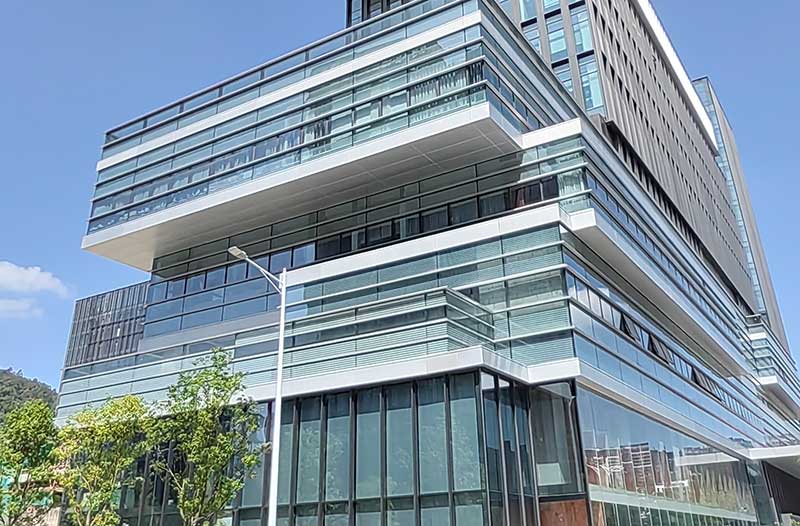
3. Structural and Performance Comparison
3.1 Structural System
The framed system follows anon-site assembly approach: mullions and transoms form a grid structure fixed to the building frame, and panels are installed piece by piece. Its connections are often dry-jointed for flexibility and easy adjustment.
The unitized system follows afactory prefabrication approach: each unitized panel is preassembled with glass, sealants, and fittings in the factory, then hoisted and connected on-site. Units typically feature male-female joints or EPDM gaskets to achieve superior waterproofing and airtight performance.
3.2 Airtightness and Watertightness
Unitized curtain wall systems generally providebetter airtightness and watertightness due to their continuous sealing design and dual-layer defense structure.
Framed systems, while effective with proper sealants and gaskets, rely more heavily on on-site workmanship and are therefore less consistent in sealing performance.
3.3 Safety and Structural Adaptability
The unitized system’s integral structure provides stronger resistance to inter-story drift, wind loads, and thermal expansion, making it more suitable for tall buildings.
Framed systems, on the other hand, are better suited tolow-rise or irregular facades, where flexibility in connections is advantageous.
3.4 Cost and Construction Schedule
Framed system: Lower upfront material cost but longer installation time and higher labor dependency.
Unitized system: Higher initial investment but shorter project duration, consistent quality, and lower long-term maintenance cost.
For large international projects, where time and quality are priorities, theunitized system is generally more cost-effective overall. For smaller, irregular, or complex structures, theframed system remains more adaptable.
4. Technical Considerations
4.1 Design Stage
Curtain wall design must balance architectural aesthetics, structural movement, thermal performance, and installation logistics.
Forframed systems, emphasis should be placed on mullion design and flexible connection details.
Forunitized systems, key considerations include optimizing unit dimensions, sealing methods, and transport efficiency.
4.2 Material Selection
Both systems typically employ:
Aluminum profiles: High-strength 6063-T5 or T6 aluminum alloy.
Glass: Double-glazed, Low-E tempered or laminated glass.
Sealants: Weather-resistant silicone sealants and EPDM gaskets.
Connectors: Stainless steel or galvanized steel components for long-term durability.
4.3 Fabrication and Installation
Framed system: Predominantly assembled on-site; requires precise control of vertical and horizontal alignment.
Unitized system: Factory-preassembled units transported and installed by crane, enabling simultaneous facade installation and structural work—significantly reducing total construction time.
4.4 Performance Testing and Quality Control
Curtain wall systems must undergo comprehensive testing—including air and water tightness, wind resistance, and deformation performance—per international standards (ASTM, EN, GB/T, etc.).
Unitized systems are typicallytested at the factory, while framed systems requireon-site mock-up testing for validation.
5. Global Project Applications
1.Qianhai International Financial Center, Shenzhen, China
Adopted a unitized curtain wall system combining large glass panels and aluminum cladding. Installation completed in just four months, achieving airtight performance 30% higher than national standards.
2.Dubai Creek Tower Complex, UAE
Combined framed and unitized systems to meet complex curved geometry and high wind load requirements.
3.Marina Bay Integrated Development, Singapore
Utilized a high-performance unitized system with integrated ventilation louvers and shading devices, improving energy efficiency by over 15%.
4.Eco Office Park, London, UK
Employed a framed curtain wall system designed for easy replacement and long-term maintenance, meeting BREEAM Green Building certification standards.
These examples demonstrate how both systems can adapt flexibly to diverse climates, functions, and budgets.
6. Future Trends: Smart and Sustainable Curtain Wall Systems
As architectural technology advances, framed and unitized curtain wall systems are evolving towardgreater intelligence and sustainability:
Smart control systems: Integration of sensors for automatic shading, temperature, and daylight regulation.
BIPV curtain walls: Incorporating photovoltaic modules for on-site power generation.
Low-carbon materials: Adoption of recycled aluminum and eco-friendly sealants.
Digital and modular construction: Widespread use of BIM and digital twin technology for design and project management.
The curtain wall of the future will not only be a protective facade—but an intelligent energy and information interface for the building.
7. Conclusion: Selecting the Right Curtain Wall System to Define Architectural Excellence
No matter where a project is located, selecting the appropriateframed or unitized curtain wall system is critical to its success.
Theframed system offers flexibility and easy maintenance, ideal for complex geometries and small to mid-sized projects.
Theunitized system delivers efficiency, precision, and high performance—making it the preferred choice for high-rise and international developments.
For architects, it serves as thetechnical medium that brings design concepts to life.
For developers and contractors, it ensuresquality, safety, and construction efficiency.
An exceptional curtain wall system not only defines the shape of a building—it shapes the visual identity and sustainable future of the city.
Framed and unitized curtain wall systems make buildings smarter, safer, and more beautiful.

