
In modern architecture, glass curtain walls have become a hallmark of premium projects such as commercial towers, office buildings, hotels, and residences. With their transparency, aesthetic appeal, and energy efficiency, curtain walls serve not only as a facade solution but also as a reflection of advanced design and precise construction craftsmanship. As a cladding system that separates the building envelope from its structure, their installation requires meticulous planning and execution. This article provides a professional overview of the process, key considerations, and standards for glass curtain wall installation, helping international contractors, owners, and developers achieve efficient, safe, and durable applications.
I. Preparations Before Installation
1. Technical drawings and detailed design
Prior to installation, detailed shop drawings must be developed based on the architectural facade design. These define the exact position, size, connection method, and load analysis of each glass panel. A precise design stage is critical for construction quality and future maintenance.
2. Material procurement and inspection
All materials—including glass (such as Low-E insulating glass or tempered glass) and aluminum profiles—must comply with national and international standards. Before arriving on-site, they should undergo rigorous testing, including:
Thickness and strength testing of glass;
Chemical composition and mechanical property testing of aluminum profiles;
Weather resistance checks for sealants, fireproof materials, and other accessories.
3. Site condition checks
The construction site must be equipped with lifting devices, transportation routes, and safety protection systems. For high-rise projects, detailed planning for tower cranes, gondolas, and hoists is essential.
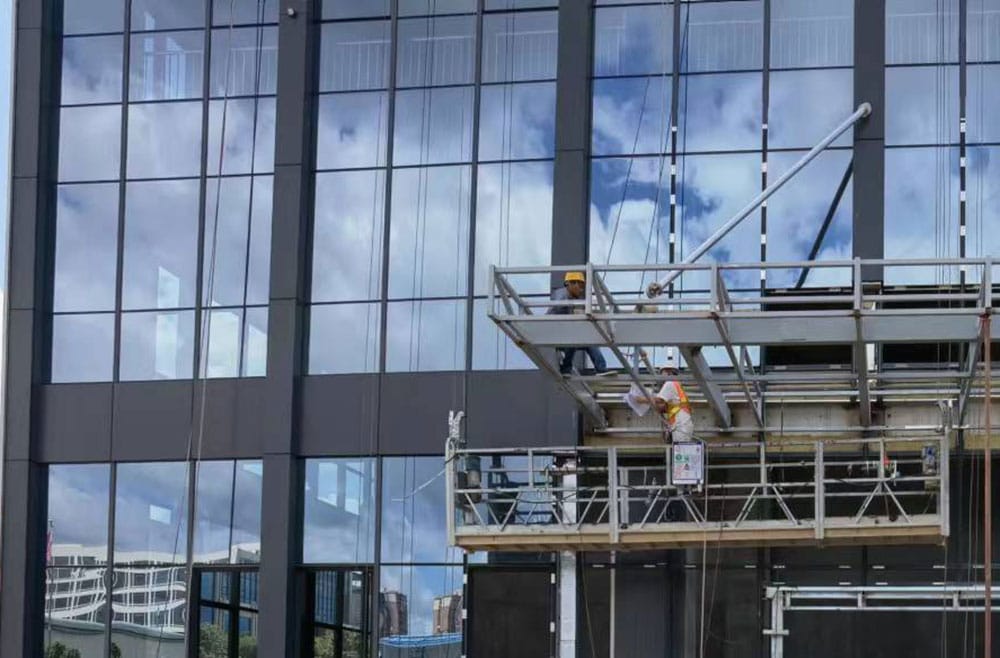
II. Step-by-Step Installation Process
1. Layout and positioning
The first step is setting out the facade gridlines and marking the positions of mullions on the structural surface. High precision is essential, as errors directly affect the curtain wall’s alignment and flatness. Total stations and laser levels are commonly used to ensure accuracy.
2. Installation of main mullions
The structural stability of the curtain wall depends on the aluminum or steel mullions. Key requirements include:
Secure connections to the main structure using embedded parts or expansion bolts;
Connection nodes with sufficient tensile and shear strength;
Verticality and flatness checks after installation.
3. Installation of transoms and sub-frames
Once the main mullions are in place, transoms and secondary framing members are fixed according to the grid design. These provide panel support, load transfer, and precise positioning.
4. Glass panel installation
This is the core step, which can be carried out in two systems:
Unitized curtain wall: Panels and frames are pre-assembled in the factory, then hoisted and fixed on-site. This method ensures higher efficiency and quality.
Stick curtain wall: Glass panels are installed piece by piece on-site, offering greater flexibility but requiring higher accuracy.
Installation guidelines:
Place rubber setting blocks under the panels to prevent direct glass-to-metal contact;
Use suction lifters for safe handling;
Maintain uniform gaps for proper sealant application.
5. Sealing and waterproofing
Weatherproofing performance relies on proper sealant application:
Use silicone structural and weatherproof sealants that meet durability standards;
Ensure all surfaces are clean and dry before sealing;
Apply sealant continuously and fully, avoiding bubbles or breaks.
Special attention should be given to corners and termination details, with additional sealing strips or flashing plates where necessary.
6. Cleaning and inspection
Once installation is complete, the facade must be thoroughly cleaned and tested. Standard inspections include:
Wind load deflection testing;
Air-tightness and water-tightness testing;
Surface defect inspection.
These checks ensure the system meets both safety and aesthetic requirements.
III. Key Control Points
1. Accuracy: Strictly control tolerances, especially panel gaps, to avoid stress cracking caused by thermal expansion.
2. Safety: High-rise works require safety nets, lifelines, and gondolas. Workers must wear harnesses at all times.
3. Environmental adaptation: Consider temperature, wind pressure, and seismic effects during installation to ensure long-term stability.
4. Maintenance planning: Curtain wall systems should integrate access solutions such as cleaning tracks or gondola rails for long-term upkeep.
IV. Common Issues and Solutions
1. Water leakage: Usually caused by poor sealant application or inadequate detail design. Solution: apply double-seal systems and strengthen quality control.
2. Glass breakage: Often due to nickel sulfide inclusions in tempered glass or excessive installation stress. Solution: use high-quality glass and avoid hard contact during installation.
3. Poor acoustic performance: Select insulating or laminated glass and ensure proper frame sealing.
4. Insufficient thermal performance: Use Low-E coated glass and thermal-break aluminum profiles to improve energy efficiency.
V. International Trends in Curtain Wall Systems
With the advancement of green and smart buildings, glass curtain walls are evolving in the following directions:
Energy-efficient facades: Incorporating double or triple Low-E coatings to enhance insulation.
Smart facades: Integration of photovoltaic panels and smart-tinting glass for sustainable and aesthetic solutions.
Industrialized installation: Higher prefabrication ratios in unitized systems, shortening construction cycles and reducing on-site risks.
For developers and contractors, selecting partners with strong R\&D capability, large-scale production, and full lifecycle service is essential.
A glass curtain wall is more than just an architectural skin—it is a synthesis of safety, energy performance, and design. High-standard installation ensures not only lasting beauty but also structural reliability. Developers and contractors are advised to work with professional companies that offer international R\&D expertise, intelligent production, and global service networks.
If you are planning or executing a curtain wall project, partnering with an experienced team for design, fabrication, installation, and maintenance will guarantee superior results. Contact ZDMQ today to collaborate with trusted curtain wall experts and build a safer, more beautiful urban future.

