
The building facade is no longer just decoration—it has become a vital element that reflects value, functionality, and image. Whether it’s an office tower, shopping mall, hotel, factory, or high-end residential project, developers and owners want facades that are not only aesthetically impressive but also durable, safe, and easy to maintain.
However, many traditional facade materials still present several challenges:
Limited appearance: Conventional brick walls or stone facades lack modernity and cannot meet the aesthetic needs of high-end commercial properties.
Maintenance issues: Some facade materials fade, crack, or peel easily, making buildings look old after only a few years.
Insufficient performance: Thermal insulation, soundproofing, and energy efficiency often fall short of modern green building standards.
Against this backdrop, exposed frame glass curtain walls have emerged as a solution. As one of the most widely used curtain wall systems, they overcome the shortcomings of traditional facades while offering beauty, practicality, and cost-effectiveness, making them the preferred choice for many projects.
Key Features and Advantages of Exposed Frame Glass Curtain Walls
1. Clear Structure, Easy Installation
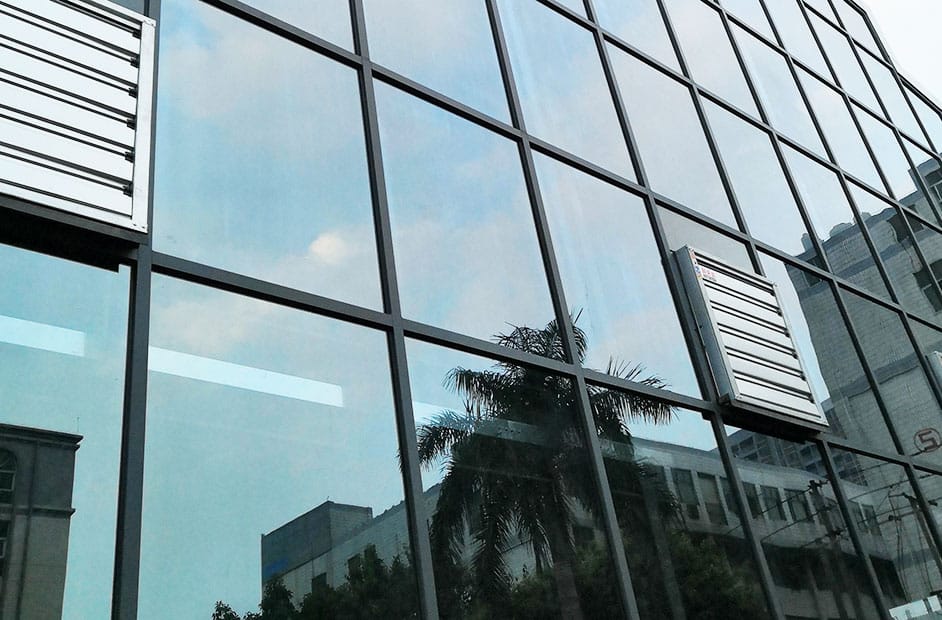
The defining characteristic of exposed frame glass curtain walls is that the mullions and transoms are clearly visible on the facade, with glass panels embedded within the aluminum frame. Compared with hidden frame systems, their structure is more straightforward, making installation easier and construction periods shorter.
Application scenario: Office buildings with tight construction schedules often choose exposed frame systems to ensure both quality and efficiency.
Advantage summary: Simple installation, lower error rate, easier maintenance.
2. Sleek Appearance, Flexible Design
Although the frames are visible, modern aluminum profiles can be designed with ultra-narrow widths, ensuring a clean, transparent look. Moreover, the linear grid of mullions and transoms creates a unique architectural aesthetic.
Case reference: In landmark buildings, designers often use exposed frames deliberately to emphasize rhythm and order.
Advantage summary: Balances modern aesthetics with functionality.
3. Stable Performance, Strong Adaptability
Exposed frame systems feature mature sealing and drainage designs, which effectively address wind pressure resistance, water leakage, and airtightness.
Application scenario: In coastal cities prone to typhoons, exposed frame systems significantly enhance facade stability.
Advantage summary: Safe, reliable, and durable.
4. Cost-Effective
Compared with hidden frame or all-glass curtain walls, exposed frame systems are more economical in both manufacturing and installation. For owners with limited budgets but high demands for modern facades, this system offers excellent value.
Application scenario: Commonly used in mid- to high-end residential projects and business offices.
Advantage summary: Balanced investment with impressive results.
5. Easy Maintenance
Since the structural frame is visible, any broken glass or aged sealant can be quickly identified and replaced.
Application scenario: For shopping malls and hotels that must maintain a consistent image, easy maintenance is a major advantage.
Advantage summary: Lower long-term maintenance costs, longer service life.
Case Studies
Case 1: Grade-A Office Building in Shanghai
Located in the city center, the developer required a facade that was modern, with controlled costs and a tight construction schedule. An exposed frame system was chosen, allowing the facade installation to be completed in just eight months—one-third faster than traditional stone facades. The completed building presented a clean, modern look that was highly praised by tenants.
Case 2: Large Shopping Mall in Shenzhen
The mall required maximum daylighting during the day and a vibrant illuminated effect at night. The exposed frame system not only provided excellent natural lighting but also created an orderly grid that worked perfectly with LED lighting, making the facade an iconic visual element of the project.
These examples demonstrate that exposed frame glass curtain walls are suitable for not only high-end office and commercial projects but also residential developments.
Comparison with Alternative Systems
1. Versus Hidden Frame Curtain Walls
Hidden frame systems provide a seamless glass surface and a more transparent appearance but are costlier and harder to install.
Exposed frame systems, while visibly framed, are simpler, more affordable, and easier to maintain.
For projects prioritizing practicality and cost-effectiveness, exposed frame systems are often the best choice.
2. Versus All-Glass Curtain Walls
All-glass facades offer ultimate transparency but require complex structures, are very expensive, and more challenging to maintain.
Exposed frame systems strike a balance between aesthetics, cost, and safety.
3. Versus Stone or Aluminum Panel facades
Stone or aluminum panels appear heavy and lack modern appeal, with poor daylighting.
Exposed frame glass curtain walls enhance transparency and create a contemporary appearance.
Overall, exposed frame glass curtain walls excel in cost, installation efficiency, performance, and maintenance, making them highly suitable for most commercial and residential projects.
With rising expectations for building facades, exposed frame glass curtain walls are becoming the preferred solution. They meet both aesthetic and functional needs while keeping budgets and schedules under control.
If you are considering the right curtain wall system for your project, exposed frame systems offer:
A modern, sophisticated appearance
Lower long-term maintenance costs
Outstanding value within budget
Contact our professional team to receive tailored design and quotation services. Whether it’s an office tower, shopping complex, or residential project, we can deliver customized exposed frame glass curtain wall solutions.
Make your building stand out—starting with the facade.

