
In Africa, urbanization is accelerating. Whether for commercial complexes, office towers, or high-end residential projects, the expectations for building façades are rising. Traditional brick walls and painted exteriors are no longer sufficient to meet modern demands for aesthetics, daylighting, and energy efficiency. Against this backdrop, glass curtain walls are steadily entering the African construction market.
But one question is often asked by developers and property owners: What is the price of glass curtain walls per square meter in Africa?
There is no single answer, as the cost depends on materials, design, installation, and the country where the project is located. Let’s break it down in detail.
Why do local clients choose glass curtain walls?
1. Enhance project value
In cities such as Nairobi, Lagos, and Cairo, more and more office towers and shopping malls are adopting glass curtain façades. A building’s appearance directly affects rental levels and clients’ first impressions. Studies show that office buildings with curtain walls can command 15–25% higher rents than traditional brick-wall buildings.
2. Improve indoor comfort
Many African countries experience hot climates. With only brick walls and standard glass windows, indoor temperatures rise sharply, leading to higher air-conditioning costs. Insulated glass and Low-E coated curtain walls help reduce heat gain, cutting energy bills by about 30%—a long-term cost-saving strategy for operators.
3. Align with modern urban development
As African nations attract foreign investment and build modern cities, landmark projects demand striking façades. Curtain walls not only deliver a contemporary look but also serve as city icons. For example, Addis Ababa’s CBD features several full-glass curtain wall buildings that have become recognizable landmarks.
Advantages of glass curtain walls in Africa
Material availability: Some African countries now have local aluminum processing plants and glass supply chains. Combined with imports from China and the UAE, sourcing materials is far easier than in the past.
Growing technical expertise: Experienced international suppliers have set up offices or local partners in Africa, providing design, fabrication, and installation services.
Cost-effectiveness: Compared with stone or metal panel façades, curtain walls strike a better balance between aesthetics, daylighting, and energy efficiency.
Climate adaptability: Whether in Nigeria’s hot, humid climate or Kenya’s highland regions with wide temperature variations, curtain walls can be tailored with different glass configurations.
Reference prices for glass curtain walls in Africa
For many, the most important concern is cost. Based on common aluminum-framed systems, here is a rough guide:
1. Basic systems (single glass + standard aluminum profiles)
Approx. USD 150–200 per m²
Suitable for mid- to low-end commercial or residential projects with strict budget control.
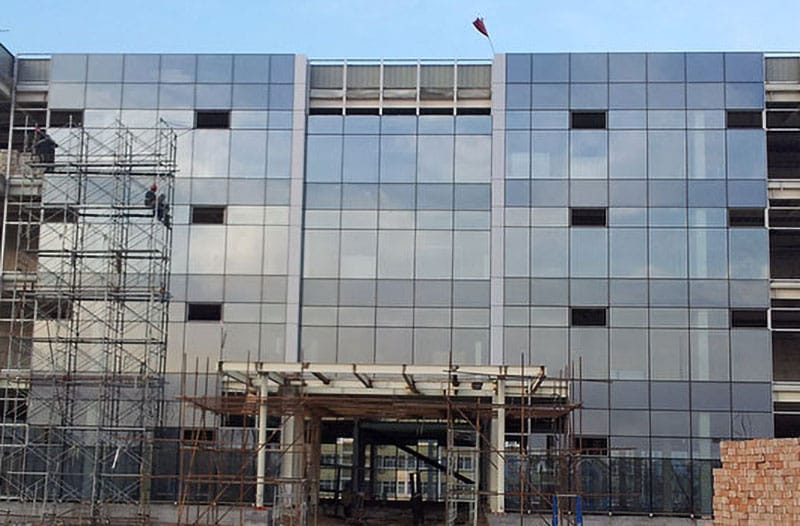
2. Mid-range systems (insulated glass + standard thermal aluminum profiles)
Approx. USD 190–290 per m²
Popular for offices, hotels, and apartments; best value for money.
3. High-end systems (Low-E coated glass + thermal break aluminum profiles + customized design)
Approx. USD 310–420 per m²
Special shapes or point-supported systems may cost more.
Typically used in government buildings, landmarks, or premium commercial projects.
Prices also vary by country and city. For example, Nigeria’s higher import taxes push costs upward, while in Kenya, competition among Chinese contractors makes prices more competitive.
Case studies: trusted suppliers and successful projects
Case 1: Office tower in Nairobi, Kenya
A Chinese supplier delivered a 30,000 m² curtain wall using insulated Low-E glass. After completion, the building’s annual energy consumption dropped by about 20%, and rents were 18% higher than nearby conventional office buildings.
Case 2: Shopping mall in Lagos, Nigeria
The owner initially considered brick walls with windows but later chose a curtain wall solution. Although upfront costs were 25% higher, the visual appeal attracted far more foot traffic. After opening, shop rental occupancy reached nearly 100%.
These examples show that reliable suppliers can help clients save on long-term operating costs while providing design and maintenance support.
FAQ: Common questions about glass curtain walls in Africa
Q1: Are curtain walls suitable for hot climates in Africa?
Yes. Double-glazing and Low-E coatings effectively reduce heat transfer, lowering air-conditioning loads.
Q2: Is transportation and installation difficult in Africa?
Not necessarily. Most suppliers provide end-to-end services, including international shipping and on-site installation guidance. Many Chinese companies already have mature logistics and construction experience in Africa.
Q3: Is maintenance expensive?
Curtain walls do require regular cleaning, but overall maintenance costs are lower than stone façades, which need frequent refurbishment. In some regions, self-cleaning glass can further reduce upkeep.
Q4: Should I choose a local supplier or import from abroad?
For small-scale projects, local suppliers may be more economical. For large projects, however, international suppliers with overseas experience are recommended, as they provide better design and technical expertise.
Final thoughts
If you are planning a commercial building, residential estate, or government project in Africa and are concerned about curtain wall pricing and supplier selection, start by clarifying your project positioning and budget. Then compare proposals and quotations from different suppliers.
Remember: the cheapest option isn’t always the best. A reliable, long-term curtain wall solution is the real key to protecting your building’s value.
For detailed cost estimates or to connect with experienced glass curtain wall suppliers, feel free to contact us:
📞 (+86) 17721781439
📧 [Monikachenwall@Gmail.com]

