
In modern architectural design, we often come across the term “full glass curtain wall.” Many people, when looking at shopping malls, office buildings, or landmark structures, are captivated by their crystal-clear, transparent façades, most of which are closely related to full glass curtain walls. However, for the general public, what a full glass curtain wall actually is, why it is so widely used, and whether it is suitable for homes or small buildings remains unclear. Today, ZDMQ will share some insights about full glass curtain walls.
What is a Full Glass Curtain Wall
From a professional perspective, a full glass curtain wall refers to a curtain wall system that does not rely on traditional metal frames for support but instead uses glass itself as the main load-bearing and enclosure structure. It is usually connected to the main structure with point-type metal fittings, tension rods, or cables, making the façade appear as though it is made entirely of glass. This is why full glass curtain walls are often called “frameless curtain walls” or “point-supported curtain walls.”
In simpler terms, a full glass curtain wall minimizes visible frames so that the building’s exterior looks like one continuous, crystal-clear glass screen. This visual effect conveys a modern, lightweight, and open architectural expression.
Why Full Glass Curtain Walls are Popular
Maximum Transparency and Daylighting
The most attractive feature of a full glass curtain wall is its ability to maximize natural light. According to the *Architectural Light Environment Standard*, offices using full glass curtain walls achieve 28%–35% better daylighting compared with traditional curtain walls. This not only reduces the need for artificial lighting but also creates a healthier and more comfortable environment.
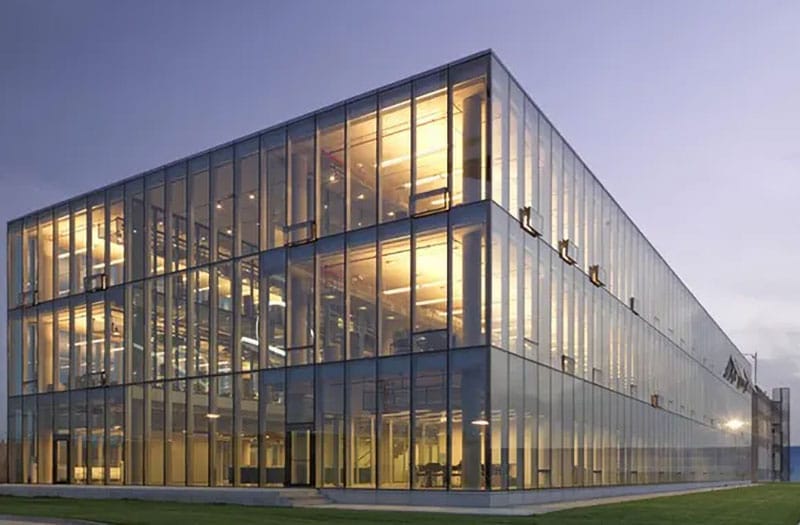
For example, a large financial center in Shanghai adopted extensive full glass curtain walls, and employees reported a brighter workspace and reduced psychological stress. This user-friendly experience highlights the unique value of this design.
A Symbol of Modern Aesthetics
Full glass curtain walls create a futuristic look. In high-end commercial complexes or luxury hotels, such designs often symbolize modernity and sophistication. A commercial tower in Philadelphia, USA, became a city landmark precisely because of its full glass curtain wall, elevating not only its image but also the value of the surrounding properties.
Enhanced Spatial Interaction
Compared with traditional façades, full glass curtain walls better integrate indoor and outdoor spaces. For instance, in shopping malls, this design removes the visual barrier between inside and outside, allowing passersby to see activities and displays indoors, thereby attracting more foot traffic. This “display effect” is something ordinary curtain walls cannot match.
Challenges of Full Glass Curtain Walls
Like any architectural form, full glass curtain walls have both pros and cons. While understanding what they are, we must also recognize the challenges.
Energy Consumption
A common concern is that full glass curtain walls may cause overheating in summer and heat loss in winter. This issue is more pronounced if regular glass is used. However, with the growing use of insulated glass and Low-E coated glass, these problems are being mitigated. For example, a major shopping center in Shenzhen used triple Low-E insulated glass during renovation and reduced annual HVAC energy consumption by about 15%.
Higher Costs
The construction cost of a full glass curtain wall is relatively high. While traditional curtain walls cost about 800–1300 RMB per square meter, full glass curtain walls usually range from 1500–2900 RMB per square meter or more. For smaller projects with limited budgets, this may be a significant burden.
Structure and Safety
Since glass is a brittle material, full glass curtain walls require high-strength tempered or laminated glass, supported by precise fittings and installation. For example, a high-rise office tower in Guangzhou used 19mm ultra-clear tempered laminated glass combined with stainless steel spider fittings to ensure safety.
Typical Applications
Commercial Complexes
Shopping centers, exhibition halls, and office towers almost always feature full glass curtain walls. They not only create a grand appearance but also enhance customer appeal.
Public Buildings
Airports, museums, and libraries often require openness and transparency, which full glass curtain walls deliver exceptionally well.
High-End Residences
Though not common in regular homes, full glass curtain walls are sometimes used in villas or luxury homes, such as in living rooms or poolside façades, to create unique lifestyle experiences.
A few years ago, I participated in a project in a coastal city in East China, commissioned by a well-known real estate company. The debate was whether to use full glass curtain walls due to cost and energy concerns. Ultimately, we opted for partial use: the office tower featured a full glass curtain wall, while the commercial section combined it with metal frames. The outcome was excellent, with the office tower achieving a 12% higher occupancy rate compared to nearby competitors, proving that this design is not only visually impressive but also economically beneficial.
Common Questions about Full Glass Curtain Walls
Q1. What is a full glass curtain wall
In short, it’s a curtain wall with minimal visible framing, consisting primarily of glass panels and fittings, resulting in a highly transparent façade.
Q2. Is it suitable for regular homes
From cost and energy perspectives, large-scale use is not recommended for typical homes, but partial application is feasible.
Q3. Is it safe
Yes, provided that qualified tempered or laminated glass is used and installation is done by a professional company, the safety is reliable.
Q4. Is maintenance difficult
It is somewhat more complex than traditional curtain walls, especially for high-rise cleaning, but professional services can manage it effectively.
So, what is a full glass curtain wall It is not just an exterior design but a modern architectural language symbolizing openness, transparency, and style. Its advantages lie in lighting, aesthetics, and spatial integration, while its drawbacks include energy consumption, cost, and maintenance.
For property owners, whether to adopt a full glass curtain wall depends on budget, function, and climate conditions. For high-end commercial and public buildings, it is undoubtedly a powerful tool to boost image and value. In residential settings, it works better as an accent design.
Looking ahead, as energy-saving glass and green building technologies become more widespread, full glass curtain walls will likely gain even broader adoption. One day, they may become as common in daily life as today’s floor-to-ceiling windows.

